Thursday, August 28, 2008
Display problem ? Click HERE
Recommended :
- Tips on Succession in FREE Subscription
- Subscribe FREE - Processing & Control News

There are many ways to obtain the Dynamic viscosity of water. You may use Steam table, Excel calculator using Water97_v13 add-in, Steam Calculator (web), SteamTab program, simulator like HYSYS, etc. All above required you to have the material on hand.
Following is a simple equation to estimate the Dynamic Viscosity of Water. It is easy to be written in your notebook or memorize.
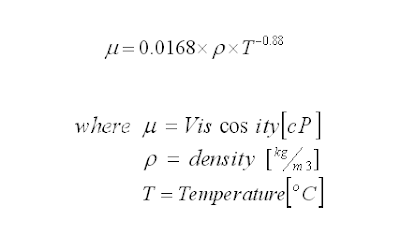
*Applicable in water temperature of 25-250 degC
Earlier post "Conduct Steam-Water Balance MANUALLY using Water97_v13" has discussed the Dynamic Viscosity can be extracted using a special function, viscW(T,P) in Excel Add-on in (Water97_v13.xla or Alternative download). The dynamic viscosity of water at different temperature from 30 to 250 degC (at 40 barg) have been predicted using Water97_v13.xla and Dynamic Water Viscosity formula . Results tabulated as follow :
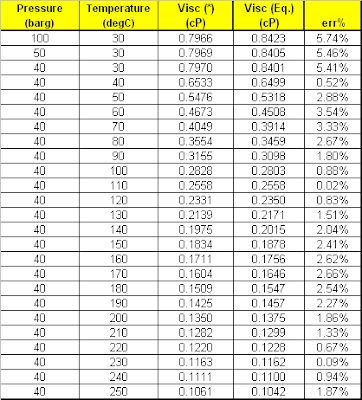
The error is 01-3.5% with maximum 5.75% at low temperature. It is consider rather sufficient from engineering perspective and pretty useful when you have nothing on hand.
Related Topic
Earlier post "Conduct Steam-Water Balance MANUALLY using Water97_v13" has discussed the Dynamic Viscosity can be extracted using a special function, viscW(T,P) in Excel Add-on in (Water97_v13.xla or Alternative download). The dynamic viscosity of water at different temperature from 30 to 250 degC (at 40 barg) have been predicted using Water97_v13.xla and Dynamic Water Viscosity formula . Results tabulated as follow :
The error is 01-3.5% with maximum 5.75% at low temperature. It is consider rather sufficient from engineering perspective and pretty useful when you have nothing on hand.
Related Topic
- Conduct Steam-Water Balance MANUALLY using Water97_v13
- SteamTab - A simple Executable file for Steam - Water Properties...
- Useful Steam - Condensate Calculator
- Steam - Condensate Useful Links...
- Square-root-Square-root Formula Ease Saturated Steam-Codensate Temperature Prediction
- Steam in FIRE...
- "Fire from Ice"...
Labels: Rule-Of-Thumb, Steam


Thursday, June 12, 2008
Display problem ? Click HERE
Recommended :
 You are assigned to site to make a site visit. Your task is to investigate the serious water hammering issue in the condensate line. In the plant, you found a condensate return line with a pressure gauge indicating 10 barg, you would like to know the temperature of the condensate.
 What is the quickest way to find this temperature with your pocket calculator ?
The simple Square-root-Square-root formula will help you. The formula is :
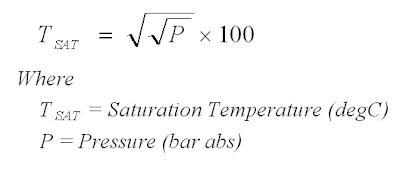
Earlier post "Conduct Steam-Water Balance MANUALLY using Water97_v13" has discussed the saturate steam - condensate temperature can be extracted using a special function, tSat(P) in Excel Add-on in (Water97_v13.xla or Alternative download). Of course, HYSYS has the capability of predicting the saturated steam-condensate temperature. The Saturation temperature at different pressure from 0 to 200 barg have been predicted using HYSYS, Water97_v13.xla and Square-root-Square-root formula. Results tabulated as follow :
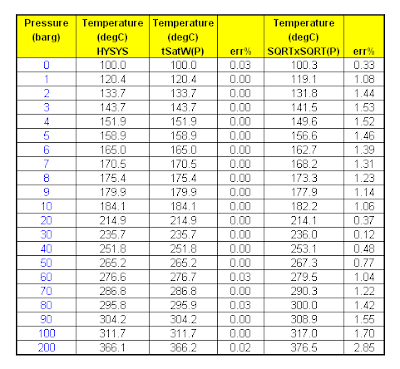
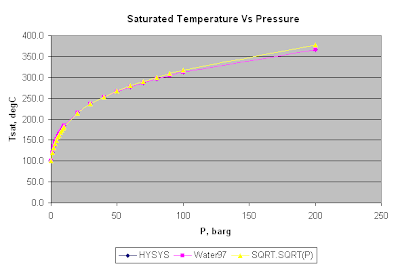
Above simple studies showed that :- tSATW(P) function in Water97_v13.xla is virtually same as HYSYS prediction. Error is negligible.
- Square-root-Square-root formula (compare to HYSYS) constantly over predict saturation temperature over the pressure range from 0-200 barg.
- Square-root-Square-root formula (compare to HYSYS), over-predict is increased with pressure.
- Square-root-Square-root formula (compare to HYSYS) prediction error in the range of 0.3 to less than 3%.
In view of above error, 0.3 to 3% error is rather small and Square-root-Square-root formula can be used to make a quick prediction of saturation temperature for steam-condensate.
Updated on June 15, 2008
- Unit P shall be in bar abs instead of barg. Thanks to Manjushinee.
Related Topic
Updated on June 15, 2008
- Unit P shall be in bar abs instead of barg. Thanks to Manjushinee.
Related Topic
Labels: Rule-Of-Thumb, Steam
Thursday, November 22, 2007
Display problem ? Click HERE
Heuristic is method, tricks & tips that common used to helps in approaching a problem. It is a compilation of knowledges and experiences by most (if not all) individual. It helps to tackle problem in a simple, reasonable and generally optimized ways and to avoid repetitive common failure.
Similar to other sectors and disciplines, most credible Chemical and Process Engineers have put a lot of efforts in compilation of their knowledges, experiences, etc and produced Heuristic dedicated to Chemical & Process Engineering...
In my process design career, i have found two most credible and reliable Heuristic in Chemical & Process Engineering.

"Although experienced engineers know where to find information and how to accurate computations, they also keep a minimum body of information in mind on the ready, made up largely of shortcuts and heuristics. the present compilation may fit into such a minimum body of information, as boost to memory or extension in some instances into less often encountered areas."

"Experience is typically what turns a good engineer into a greater engineer. An engineer that can look at a pipe and a flowmeter and guess the pressure drop within 5%. Someone who can at least estimate the size of a vessel without doing any calculations. When I think of such rules, two authors come to my mind, Walas and Branan. Dr. Walas' book, Chemical Process Equipment: Selection and Design has been widely used in the process industry and in chemical engineering education for years. Mr. Branan has either helped write or edit numerous books concerning this topic. Perhaps his most popular is Rules of Thumb for Chemical Engineers. areas."
These articles are available FREE for all in our community. If you don't aware of these articles, please read them. I am sure that you will benefits in the future Chemical & Process Engineering career.
My 2-cents advice
One shall always keep in mind that these articles are the best effort by most credible engineers. The heuristic and recommended rule of thumbs are experience and case specific. It is NOT some compulsory rule that we needs to comply to. It provides guideline to approach problem but engineering judgment and detailed calculation and design shall be conducted for final confirmation.
Last but not least, please rate this article and provide your valuable comments. Your 10 second of effort worth million to me...
Further Reading :
Labels: Education, Learning, Rule-Of-Thumb
Wednesday, August 1, 2007

Plate Heat Exchanger having narrow channel most probably "not recommended" for fluid contains solid and/or slurry services. However, there are still many success story of using PHE in abovementioned services.
There are some rule-of-thumbs to gage if a plate heat exchanger suitable for fluid contains solid or slurry :
i) 80% of the particles are less than 70% of the interplate gap on the heat exchanger.
ii) 100% of the particles are less than 90% of the interplate gap
iii) Flowing velocity is below erosional velocity (causes premature plate failure)
iv) The minimum wall temperature is above a point where crystal growth is expected.
Further reading
Labels: Heat Exchanger, PHE, Plate Heat Exchanger, Rule-Of-Thumb, Slurry, Solid
