Monday, June 23, 2008

Subscribe FREE - Chemical Processing
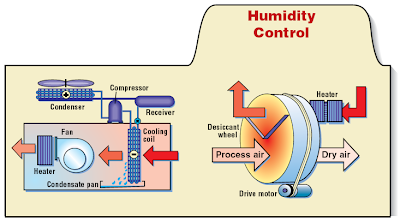
 Chemical Engineering JUNE 2008 release has shared a new FAYF. This FAYF is related to some tips on Dehumidification.
What is Dehumidification ?
Chemical Engineering JUNE 2008 release has shared a new FAYF. This FAYF is related to some tips on Dehumidification.What is Dehumidification ?
Dehumidification is a process to reduce the level of humidity in air to a level for good health, cleanliness and preserve structure & quality of material.
Why dehumidify air ?
Human health - As humid air can cause mold and mildew to grow inside homes, it potentially increases human health risks.
Why dehumidify air ?
Human health - As humid air can cause mold and mildew to grow inside homes, it potentially increases human health risks.
Prevent moisture regain
- Dried food such as rice, bread, etc are dry in nature to maintain it structure, avoid mold growth and low decaying process, . Maintaining moisture in air prevent dry food becoming wet.
Prevent condensation - Moisture in are contact with cold surface like refrigerant pipe, fridge, etc would cause condensation.
Prevent corrosion - Condensed water on metal surface would promote corrosion.
Drying - Dried air can be used to reduce moisture content in product.
How air is Dehumidify ?
Three methods are common used in dehumidifying. There are :
(i) Cooling
- Cool air below dew point and moisture in the air is condensed and drained out.
How air is Dehumidify ?
Three methods are common used in dehumidifying. There are :
(i) Cooling
- Cool air below dew point and moisture in the air is condensed and drained out.
(ii) Adsorption
- Humidity is reduced with an adsorbent material as silica gel or activated alumina. Adsorption is a physical process where moisture is condensed and kept in material. Adsorbent material can be reactivated by passing hot gas.
(iii) Absorption
- Humidity is reduced with an absorbent material such as calcium chloride solution. Absorption involves a change in the physical or chemical structure of the material.
In this FAYF, only Cooling and Adsorption process are discussed.
In addition, the FAYF briefly compare the advantages and disadvantages of Cooling and Adsorption process. Basically cooling is economic and consider when dew pointing level is not that stringent. Adsorption process is used when a very dry air is required.
Read more in...
FAYF - DEHUMIDIFIER
(Click here*)
(Click here*)
Note :
*This FAYF is only available FREE to Chemical Engineering Magazine registered user. Login required. Registration FREE.
** Download immediately as article available FREE within short period (JUNE 2008 only)
*** Found lost link or unable to download, may contact me...
Technology
** Download immediately as article available FREE within short period (JUNE 2008 only)
*** Found lost link or unable to download, may contact me...
Technology
- FAYF - Acid Solution Storage
- FAYF - Flowmeter selection in brief...
- FAYF - TIPS on Heat Transfer Fluid
- FAYF - Heat Transfer - Useful Heat Transfer Equation
- OGT - Others FREE articles related to Amine & CO2...
- Optimized Gas Treating, Inc. (OGT) - Experts in CO2-Amine
- GTC - Technology Provider for naphtha processing to terephthalic acid purification
Labels: Absorption, Adsorption, Corrosion, Heat Transfer


Saturday, May 26, 2007

Following earlier introduction to <<Optimized Gas Treating, Inc. (OGT) - Experts in CO2-Amine>>, there are some others FREE articles available on this site for download...Refer to below listing and relevant links...ENJOY...
By the way, if you know some good site related to Chemical & Process Engineering, (as you know, i am focusing on distillation recently) do recommend to me...i will crawl the website thoroughly...and let inform our lovely Chemical & Process Engineers...
Knowledge does not belongs to any of us but it belongs to ALL of US...Let Share It...I still believe the more you share, the more you will gain...
Related Post- ProMax from BR&E - Renowed Process Simulator in Gas Treating Industry
- Optimized Gas Treating, Inc. (OGT) - Experts in CO2-Amine
- Air Pollution Control & Tail Gas Treatment
Labels: Absorption, Air Pollution Control, Amine, Column, Design, Distillation, Global warming, Modelling, Packed Column, Packing, Process simulation, Tail Gas Treatment, Technology, Tower internals
Friday, May 25, 2007

Carbon Dioxide (CO2) is known as one of industrial waste gas causing global warming...there are number of measures are implemented to reduce global warming. CO2 reduction measures are CO2 capturing, reinjection into aquifer, injection into reservior for well maintenance, gas injection for enhanced oil recovery (EOR), etc.
Above efforts will reduce CO2 release into atmosphere. However, recycling CO2 will increase quantity of CO2 in oil and result serious corrosion problem. Hence it needs to be removed from the flashed gas (from unstabilised oil). CO2 removal technology using amine absorption has been used for many years. Recently i found a website (OGT) where the founders, Ralph Weiland and Jack Dingman are those experts in this technology.
Optimized Gas Treating, Inc. (OGT) was established in 1992 by Ralph Weiland and Jack Dingman for the single purpose of providing a commercial version of a Windows-based software package for simulating acid gas removal with aqueous alkanolamines that uses a fundamental mass and heat transfer rate approach to column modeling. ProTreat™ is the culmination of more than 30 years of research in gas treating supported by government and industry in both academic and commercial environments. ProTreat is our sole product. Consequently, it receives our undivided attention in maintaining and enhancing its capabilities so that it remains the premier software package for gas treating with amines. OGT’s principals are recognized world experts in most aspects of gas treating — they offer a total of nearly 60 years of relevant experience.
Some FREE articles offered by OGT :
Column related
WebWorm
Labels: Absorption, Amine, Column, Distillation, Equilibrium, Extraction, Global warming, Modelling, Packed Column, Packing, Process simulation, Software, Technology, Tower internals
Wednesday, May 23, 2007

This is a site recommended by KATMAR where i crawled earlier...Read earlier post...
Ceilcote Air Pollution Control (CAPC) is EPC company in solving environmental control. CAPC design, fabricate, install and service a complete line of air pollution control equipment.
CAPC products line includes :
...
Tellerette packing is a special design offered by CAPC...
Read...Tellerette Tower Packing Benefits/Features, How it Works, Benefits/Features and Tellerette packing technical Data Sheet
CAPC offer FREE articles / Brochures for many type of scrubber...most of the scrubber design is particularly for dust, tail gas control purposes...
Concurrent Packed Scrubbers
Crossflow Packed Scrubbers
Vertical Air Washers
FRP Venturi Scrubbers for Corrosive Applications
Horizontal Air Washer
Crossflow Packed Scrubbers
Vertical Air Washers
FRP Venturi Scrubbers for Corrosive Applications
Horizontal Air Washer
WebWorm
Labels: Absorption, Air Pollution Control, Mist Eliminator, Packed Column, Packing, Scrubber, Separator, Tail Gas Treatment, Tower internals
Tuesday, May 1, 2007

ChemSep is a software system for simulation of distillation, absorption, and extraction operations.
Built in features
- integrates flash calculations
- classic equilibrium stage column model
- non-equilibrium or rate-based column model
- export results to spreadsheet, text, and html.
- stand-alone mode as well as in flowsheet via CAPE-OPEN

Special features ChemSep 6 for Windows
- Residue Curve Maps
- Ternary VLE diagrams
- Parametric Study Mode
- CAPE OPEN (CO) compliance
- SulCol integration
- Constant relative volatility thermodynamic model
- New features added in 2006
FREE download
ChemSep-LITE is available for FREE download and is now CAPE-OPEN compliant (article in NPT). It can be used as a stand-alone column simulator or as a unit operation model inside any CO compliant flowsheet simulation program such as ASPEN Plus or COCO. ChemSep-LITE includes the equilibrium column model and is limited to 5 components and 50 stages. 
ChemSep book is available FREE for download
"Performance of a commercial scale 14% hole area sieve tray", Ind. Eng. Chem. Proc. Des. Dev., Vol. 21 (1982) pp. 712-717. FRI total reflux experiments published by T. Yanagi, M. Sakata
[Excel]
Note :Installed ChemSep LITE in order to be able to recalculate the spreadsheet.
PhD. thesis of Harry Kooijman, Dynamic Nonequilibrium Column Simulation,
PhD. thesis of Arnoud Higler, A Nonequilibrium Model for Reactive Distillation.
PhD. thesis of Richard Baur, Modeling Reactive Distillation Dynamics.
WebWorm
Labels: Absorption, Distillation, Equilibrium, Extraction, Non-Equilibrium, Software
