Wednesday, December 7, 2011

- Brazed Aluminium Heat Exchanger (BAHX) Standard
- PFHE & CWHE Comparison in LNG Plant
- Control Around Heat Exchanger
- FAYF - Useful Heat Transfer Equation
- Few Tips on Energy Efficient & Recovery
- Heat Transfer - Internal and External Flow
- FREE E-book........A Heat Transfer Textbook
- Typical Heat Transfer Coefficient For Air-Cooled Heat Exchanger
Labels: Brazed Plate Heat Exchanger, Compact heat Exchanger, Heat Exchanger, LNG


Monday, August 23, 2010

Also visit ALPEMA.
Labels: Brazed Plate Heat Exchanger, Compact heat Exchanger, Heat Exchanger
Sunday, July 11, 2010
- Intensive/excessive heat exchange (230 - 400 kW / ton LNG)
- Complex heat transfer - Heat transfer from one (or several) very high pressure natural gas stream to one or several low pressure refrigerant streams
- Thermal stress/shock - Very large temperature difference between inlet (40 degC) and outlet temperature (-162 degC)
- Operate at very low temperature (-162 degC)
- High heat transfer efficiency - Very low temperature approach (2-3 degC) to maximize heat transfer per unit area
- Involve phase change and risk of phase separation and proper distribution
- High risk of leakage and safety related issue
- High risk of blockage/plugging
- Lightweight & easy transportation
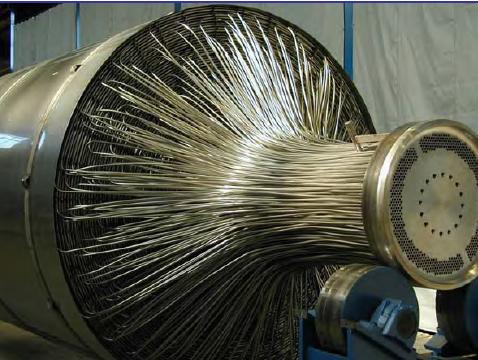

PFHE
PFHE is corrugated or serrated plate stacking on each and others to creates cross and/or counter flow paths to allow heat transfer of multiple fluids.
Although both type of HE have been widely used, CWHE and PFHE have their own special features and advantages. Below are simple comparison between both CWHE and PFHE.
| Features | Coil Wound Heat Exchanger (CWHE) | Plate-Fin Heat Exchanger (PFHE) |
| Compactness | Compact | Extremely compact |
| Heat Transfer area (m²/m³) | 20 - 300 | 300 - 1400 |
| Flow type in heat transfer | Cross-Counter | Cross and/or Counter |
| Flow pattern | Single and/or two phases | Single and/or two phases |
| Flow streams | Single or Multiple | Single or Multiple |
| Configuration | Single or multiple coil-in-vessel unit | Multiple plate-fin units |
| Flow path | 8-12mm tube | 1-2 mm flow channel |
| Risk of contaminant built-up | Less (smooth tube surface) | More (multiple channels / cores increase crevices) |
| Risk of Plugging | Lower | Higher |
| Thermal Stress Resistance | Higher (tube robustness & flexibility) | Lower (plate fin inflexible) |
| Risk of Thermal Stress | Lower | Higher |
| Gas/Liquid distribution | Less mal-distribution (single flow channel) | Higher mal-distribution (multiple unit in parallel) |
| Risk of Thermal Shock | Lower | Higher (mal-distribution lead to imbalance heat transfer) |
| Safety | Lower (tube contains within pressurized vessel - natural gas leaks to vessel) | Higher (natural gas leaks to atmosphere) |
| Availability | Higher (production continue with some tube leaks until next shutdown) | Lower (immediate production shutdown when leaks occur) |
| Transportation | Reasonable easy (with multiple bundles) | Easy (Multiple units) |
| Material | Aluminum / Stainless Steel / Carbon Steel / Others Alloy | Aluminum |
| Cost | Higher | Lower |
Related Post
- Control Around Heat Exchanger
- FAYF - Useful Heat Transfer Equation
- Few Tips on Energy Efficient & Recovery
- Heat Transfer - Internal and External Flow
- FREE E-book........A Heat Transfer Textbook
- Typical Heat Transfer Coefficient For Air-Cooled Heat
- COLLECTION of Typical Overall Heat Transfer
- COLLECTION of Fouling Factor (FF) use in Heat Exchanger Design
Labels: Brazed Plate Heat Exchanger, Compact heat Exchanger, Heat Exchanger, LNG
Friday, July 20, 2007

If you plant / maintenance engineers, you probably interested to the following articles...
FREE Operation and Maintenance Manual Available for download from POLARIS
Simpel operation guideline presented in the manual for Brazed Heat Exchanger. It covers how a brazed heat exchanger is operated, application, specification and advantages of brazed heat exchanger, installation guide, start-up & shutdown as well as cleaning procedures.
Plate-and-Frame Heat Exchanger Operation and Maintenance Manual
This manual briefly discusses a Plate Heat Exchanger Construction, function and characteristic, the gasket design, installation and start up procedures, maintenance & cleaning procedures.
Further reading...
Heat Exchanger Fouling Mechanism, Prevention and Treatment
PHE - Remove some plates, will pressure drop increase ?
ALFA LAVAL - Plate technology and Designing Plate & Frame Heat Exchanger
KOCH HTC - Special Heat exchanger provider...Twisted & Helical tube Heat exchanger
GEA - Brazed Plate Heat Exchanger
Labels: Brazed Plate Heat Exchanger, Heat Exchanger, Maintenance, Operation, Plate Heat Exchanger
Saturday, June 30, 2007

This article contains brief introductary description to several types of compact heat exchnager such as Plate Heat Exchanger, Plate-Fin heat Exchanger, Spiral Heat Exchanger, Printed Circuit Heat Exchanger, Plate and Shell Heat Exchanger and Polymer Heat Exchanger, followedby construction information, construction material, operating limits and principal application.
NTNU
Labels: Brazed Plate Heat Exchanger, Diffusion Bonded Heat Exchanger, Heat Exchanger, Plate-Fin Heat Exchanger, Polymer Heat Exchanger, Printed Circuit Heat Exchanger, Spiral Heat Exchanger
Thursday, June 21, 2007

In a Plate heat exchangers, there are number of plates for the 'hot' fluid and given number of plates for the 'cold' fluid. The cold fluid flows through the cold layers in a parallel type arrangement, same for the hot fluid. The hot fluid layers are typically laid counter-current to the cold layers. By removing plates, you will effectively be reducing the free flow area. This will increase the velocity, which is proportional to the square root of the pressure drop, it is anticipated an increase in pressure drop.
Labels: Brazed Plate Heat Exchanger, Heat Exchanger, PHE, Pressure Drop, Velocity
Friday, June 15, 2007

API Heat Transfer founded in 1947 in North America, a manufacturer for varieties of heat exchangers include Airtech Basco and Schmidt Bretten ...

HEAT EXCHANGERS...
Basco Type 500 Shell & Tube Heat Exchangers
Basco/Whitlock Hub-Design Heat Exchangers
Basco/Whitlock U-Tube Heat Exchangers
Basco Type OP Heat Exchangers
Basco PLAC Shell & Tube Heat Exchanger
Basco Type ES Extended Surface Plate Fin Heat Exchanger
API Basco Engineered Shell and Tube Heat Exchangers
Shell & Tube product literature & brochures
Airtech Aluminum Air-Cooled Heat Exchangers
Airtech Aluminum Fan-Cooled Heat Exchangers
Airtech PCR Aluminum Heat Exchangers
Air cooled product literature & brochures
Schmidt-Bretten Gasketed Plate Heat Exchangers
Semi-Welded Plate Heat Exchangers
Welded Plate Heat Exchangers
Schmidt-Bretten Brazed Plate Heat Exchangers
PHE literature & brochures
Thermal System literature & brochures
MANUAL...
Basco Type ES Installation & Maintenance Guide
Plate and Frame Heat Exchanger Installation and Maintenance Manual
Airtech Air Cooled Installation, Operating & Maintenance Instructions
ANIMATION...
Animation of Basco Type ES Disassembly
Gasketed Plate and Frame Heat Exchanger Animation
Labels: Air Cooler, Brazed Plate Heat Exchanger, Heat Exchanger, Heat Transfer, U-tube Heat exchanger
Thursday, June 14, 2007
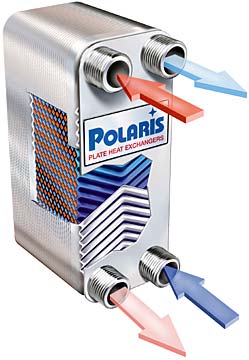
 Brazed Plate Heat Exchanger...Have you ever use it ?

GEA FlatPlate™ ... A well known Brazed Plate Heat Exchanger...
Maximum working pressures from 300 psi to 650 psi, and temperature ratings of 350°F.
Labels: Brazed Plate Heat Exchanger, Heat Exchanger, Heat Transfer