Saturday, March 27, 2010

Earth Hour 2010 will drop on March 27th, 2010, 8.30pm Local time. The effort is simple for everyone :
We in Chemical & Process, Oil and Gas industries known as one of the major "contributor" in global warming is encourage to take this opportunity to take some effort...
See more video clip in "Earth Hour 2010 - You can Help Our Friend... Environment..."
Visit Earth Hour website : http://www.earthhour.org/
Related Topic
- Earth Hour - Simple Effort Minimise Global Warming
- Green Calculator - How Much Energy Could Your Company Save ?
- Is Your Company "Green" Enough ?
- Serious Efforts In Minimising GreenHouese Effect (GHE) Emission
- Can We Really Stop Greenhouse Effect (GHE) ?
- Several Concerns in High CO2 Field Development
- Environment related...
Labels: Environment, Global warming, Greenhouse Effect


Friday, March 19, 2010
Earth Hour 2010 will drop on March 27th, 2010, 8.30pm Local time. The effort is simple for everyone. It is simple :
We in Chemical & Process, Oil and Gas industries known as one of the major "contributor" in global warming is encourage to take this opportunity to take some effort...
Visit Earth Hour website : http://www.earthhour.org/
Related Topic
- Earth Hour - Simple Effort Minimise Global Warming
- Green Calculator - How Much Energy Could Your Company Save ?
- Is Your Company "Green" Enough ?
- Serious Efforts In Minimising GreenHouese Effect (GHE) Emission
- Can We Really Stop Greenhouse Effect (GHE) ?
- Several Concerns in High CO2 Field Development
- Environment related...
Labels: Environment, Global warming, Greenhouse Effect
Wednesday, March 17, 2010
- spilled liquid volatility
- spilled liquid properties
- spilled liquid surface area expose to wind blowing
- spilled liquid temperature
- wind speed
Evaporation rate of spilled liquid can be estimated using following equation
where
E = Evaporation rate (lb / min)
U = Wind speed above spilled liquid surface (m/s)
MW = Spilled liquid molecular weight
A = Spilled liquid surface area (ft2)
VP = Spilled liquid vapor pressure at liquid temperature (mmHg)
T = Spilled liquid temperature (K)
Spilled liquid surface area (ft2)
where
V = Spilled liquid volume (ft3)
Spilled volume,
[1 ft3 = 7.48051948 US gallons]
Spilled area (without containment),
Diked area,
Since Awc is larger than Adike, entire dike area will be occupied by spilled liquid.
Inputs
U =1.5 m/s
MW =32.04
A =3371.7 ft2
VP =125 mmHg
T =25 + 273.15 = 298.15 K
Evaporation rate
Above method is a quick method in determining evaporation rate.
Related Post
- Tank Normal Venting Rate Estimation Using Latest Method As in API Std 2000
- Tank Venting - API Std 2000 (Nov 2009) - Revised method and Old Method in ANNEX A
- Tank Thermal Breathing - Proposed Equation Correlate API Std 2000 (Annex A)
- Tank Normal Venting Rate Estimation Using Siddhartha Equation
- Two Useful Equations For Flow Conversion between Air - Vapor & Actual - Standard
- Relate NORMAL to STANDARD Volumetric Flow
- Relate NORMAL to ACTUAL Volumetric Flow
- Environment related
Labels: Environment, Greenhouse Effect
Wednesday, April 22, 2009
- Why not print and keep in softcopy ?
- Don't print (hardcopy) if it is not absolutely required
- Think twice if you really want to print...
- Continue to ask similar question other than Earth day...
Related Topic
- Earth Hour - Simple Effort Minimise Global Warming
- Serious Efforts In Minimising GreenHouese Effect (GHE) Emission
- Can We Really Stop Greenhouse Effect (GHE) ?
- Is Your Company "Green" Enough ?
- CO2 to Petrol ?
- Methane Conversion Challenge
- Several Concerns in High CO2 Field Development
- Environment related...
Labels: Environment, Global warming, Greenhouse Effect
Wednesday, March 25, 2009
 Earth Hour, an annual international event created by the WWF (World Wide Fund for Nature/World Wildlife Fund) is coming back on March 28, 2009 to create awareness on global warming and the need to take action on climate change. The event has no boundary and is extended from individual to large organization, from households to business. Every living can participate...
The effort is simple for everyone. If you are participating in Earth Hour, what you need to do is :
at 8.30pm Local time
For more information, visit EarthHour
Related Topic
- Serious Efforts In Minimising GreenHouese Effect (GHE) Emission
- Can We Really Stop Greenhouse Effect (GHE) ?
- Is Your Company "Green" Enough ?
- CO2 to Petrol ?
- Methane Conversion Challenge
- Several Concerns in High CO2 Field Development
- Environment related...
Labels: Environment, Global warming, Greenhouse Effect
Friday, January 9, 2009
- Tips on Succession in FREE Subscription

Three main issues are their concerns : Safety, Environment and Security.
Safety
For the past 40 years, there are more than 25 accidents related to LNG from production plant, storage and transportation.
- Methane Princess Spill, 1965
- Jules Verne Spill, May 1965
- La Spezia, Italy, 1971
- Montreal East, Quebec, Canada, 1972
- Staten Island Tank Fire, USA, 1973
- Massachusetts Barge Spill, July 1974
- Aquarius Spill, September 1977
- Das Island, United Arab Emirates, March 1978
- Cove Point, Maryland, 1979
- Mostafa Ben Bouliad Spill, April 1979
- Pollenger Spill, April 1979
- Bontang, Indonesia, 1983
- Nevada Test Site, Mercury, NV, 1987
- Bachir Chihani, Hull Cracking, 1990
- Mediterranean Off Gibraltar
- Algeria, LNG Facility Explosion, January 19, 2004
- Trinidad Tobago, June 13, 2004
- Belgium, July 31, 2004
- Norway, September 20, 2004
- USA, March 2005
- Nigeria, August 2005
- Savannah, GA March 14, 2006
- Trinidad & Tobago May 18 & May 21 & June 6, 2006
- Jordan July 13, 2006
- Cape Cod February 11, 2008
 Environment Impact
Carbon Dioxide (CO2) is known to create severe greenhouse effect and contribute serious global warming. Many efforts such as Co2 capture and sequestration are in research and implementation in order to minimize release of Co2 to atmospheric. It is aware that 1 mole of methane is about 21 time CO2 equivalent. Those any similar quantity of LNG release would seriously results severe global warming. Again, serious safety, facilities and operational review in place to minimize the potential of LNG release to atmospheric.
Security
Following the terrorist attack to twin tower in 911 case, many security agent has postulated the danger of similar attack to plant with flammable product i.e LNG plant. This is another push to minimize LNG plant implementation. Having say that, similar risk is still applicable to other plant i.e refinery, petrochemical plant, etc. Are we going to stop implementation of all these facilities due to this factor ?
Following are some video clip related danger of LNG.
The Risks & Danger of LNG Liquefied Natural Gas
"LNG is Safe, Clean & Affordable" Liquefied Natural Gas
Another Fire Near LNG Terminal: Everett
Just say NO to LNG
Stop Global Warming - Embrace Our Live Earth
No LNG !
Labels: Global warming, Greenhouse Effect, LNG
Wednesday, August 27, 2008
- Tips on Succession in FREE Subscription
- Subscribe FREE - Recycling Today

Now you may have your own fuel filling station in your garage. You may brew your own ethanol from beets, corn, sugar cane, alcohol, leftover beer, wine, booze, etc. Produced ethanol will be stored and ready to mix with gasoline in your car gasoline tank. Together with the E-fuel carbon credit program, it is cost saver which possibly reduce the cost down to US$0.1 - US$1.0 per gallon of fuel. Apart from fuel cost reduction, ethanol also reduces C02 emissions by 85% when used in vehicles in place of gasoline. This significant helps to reduce greenhouse effect and global warming.
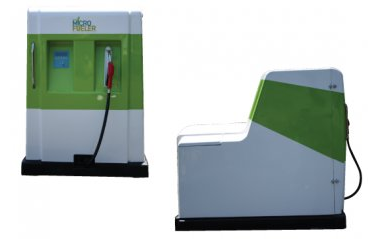
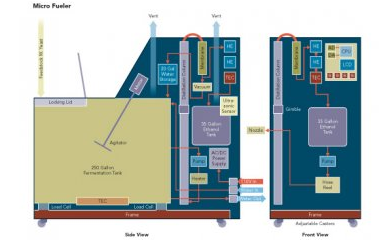
E-Fuel 100, a self-contained ethanol micro-refinery will produce ethanol to top up their gasoline tank with the aim to reduce fuel cost. E-Fuel is typically conventional alcohol brewing unit which consists of fermentation unit, distillation unit, condensation unit, storage and pumping unit and control unit.
With high energy price and tremendous pressure on pushing environmental friendly green technology, this E-fuel invention is expected to gain serious attention from consumer and law maker.
Source : "Ethanol Is The New Homebrew", Design News
Related Topic
Labels: Global warming, Green Technology, Greenhouse Effect
Tuesday, July 8, 2008
 As discussed in "Can We Really Stop Greenhouse Effect (GHE) ?", the world is running in "CO2 deficit"even though there are NO others GHE contributors. Nowadays, there are serious increases in awareness of greenhouse effect (GHE) emission and a lot of efforts and actions are taken to minimize GHE emission and to "Slow down" the GHE. Several efforts that can be carried by many of us as individual are :
- Planting - gardening, plant and maintain at least 10 trees, etc
- No open burning - Stop all open burning to recover organic substances in land for plantation purpose, mosquito expulsion in developing countries, etc
- Use Hybrid (Fuel/Elec) vehicle
- Stop smoking
- Involve in R&D
 Serious efforts from industry is also one of the most important and critical actions. Recently, IBM has listed five methods that can be used to shrink the carbon footprint. Suggestions include evaluating how much carbon your plant produces, and then pushing energy efficiency throughout operations, from product development cycles to more efficient equipment. The real value comes from end-to-end collaborative optimization.
- Diagnosis and assessment - Evaluate carbon production
- Carbon asset management - Increase energy efficiency and promote energy saving equipments
- Functional optimization - implemented throughout entire supply chain functions within the organization
- Internal horizontal integration - integrated approach across functions
- Collaborative, end-to-end optimization - Promote all players in the supply chain collaborate on end-to-end optimization
Above are some efforts listed and you may consider to apply them in your organization to improve and achieve Green Organization. To assess How green is your organization, you may read more in "Is Your Company "Green" Enough ?".
Related Topic
Labels: Environment, Greenhouse Effect
Sunday, July 6, 2008

Recommended (FREE) :
What Is ISO 14001 And Should I Care?
(USA & CANADA only)
According to a study by the United States Department of Agriculture, an average person's respiration generates approximately 450 liters (roughly 900 grams) of carbon dioxide (CO2) per day. This roughly equivalent to 900 [g CO2/day] / 1000 [kg/g] x 365 days / year = 328.5 kg CO2 / year (724.2 lb Co2 /year)Following tabulates average quantity of CO2 sequestered in a year (different species) :
- Calliandra calothyrsus (10 years old, 15 feets tall, 8 inches diameter) - 38.3 lbs CO2/tree/year
- Grevillia robusta (10-year-old, 45 feet tall, 6 inches diameter) - 64.6 lbs CO2/tree/year
- Acacia angustissima (2.5 years old, 15 feet tall, 3 inches diameter) - 21.5 lbs CO2/tree/year
- Albizzia lebbek (15 years old, 30 feet tall, 12 inch) - 68.9 lbs CO2/tree/year
- Pine and eucalyptus (mature) - 73.3 lbs CO2/tree/year
Mathematically to balance the CO2 emitted by a person is 724.2 / 73.3 ~ 10 nos of Pine & eucalptus (mature). 10 Tree per person is required to ensure the CO2 balance !!!.
Recommended (FREE) :
Gauging Green Opportunities: Taking Sustainable Building to a New Level
(USA, CANADA & UK only)
Above figure has not included the methane release by tree and person decaying process where CO2 equivalent for 1 mole of methane is about 21 time !Increasing growth rate of human being, high development and natural sources have reduced quantity of trees available for CO2 balance. Lets assume there is NO reduction of tree in the world and NO other activities (i.e. fossil fuel burning) generates CO2. This implies that we are still running in "deficit".
Can we really stop greenhouse effect (GHE) ?
Related Topic
Labels: CO2, Global warming, Greenhouse Effect
Tuesday, June 10, 2008

Have you ever heard about Green Assessment Tool ?
To begin this assessment, you just have to fill-up and answer 20 easy-to-answer questions (about 5 minutes) which basically distributed within four quadrants:
- Global Asset Sustainability
- Supply Chain
- Product/Service Development
- Organizational Readiness
Upon completion of the question, a Green benchmark in radar chart showing the current sustainability status of your company compared to the average scores of other companies that have participated. See example of radar chart below.
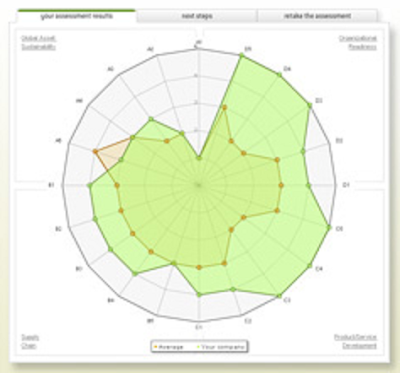
Check it here... Infor Green Assessment
Labels: Environment, Greenhouse Effect
Wednesday, June 4, 2008
 Recent disasters, Cyclone in Myanmar and Earthquake in China hint to us that our beloved earth already "Sick". We in Chemical & Process, Oil and Gas industries as known as one of the major "contributor" in damaging of earth, have you ever think, how much you have done to preserve and minimize the impact of this damage ?
Implementation of As-Low-As-Reasonable-Practical (ALARP) principle, Conversion of all venting to flaring effort, Zero flaring philosophy, "Green" equipments, CO2 capture & Sequestration, etc...in many new development has signified that many companies have taken the positive effort to minimize the impacts.

World Environment Day (WED) is one of the principal vehicles through which the United Nations stimulates worldwide awareness of the environment and enhances political attention and action.
Read more Reason & Efforts by Others
The following article is Earth-friendly and green offers you may consider (FREE.registration required).

Going Green: How Environmentally Conscious Practices and Products Present a Profitable Future Today: Can a company "go green" within its enterprise and supply chain, and get a payoff that keeps the black ink flowing? As companies get serious about reducing greenhouse gases, their biggest hurdle is the uncertainty over which approach to cutting carbon emissions makes the best financial sense. This white paper shows you a hands-on, practical perspective on how technology solutions can highlight the cost drivers behind these growing "green" issues, and offer your company reduced costs, increased efficiency, and more earth-friendly operations. It discusses key green initiatives and the emerging solutions associated with energy consumption and carbon emissions management.
Taking this oppurtunity and re-iterate some discussed effort :
- Spread the environment awareness - Blog about it, inform you junior / kits, friend around you. Or minimum inform them to read this post. Or Copy contents of this post to forum, etc and create a link to this post.
- Read it - Reading also another effort in green.
- Practise it - if you have not practised any of measures here, please practise at least ONE. If you have practised some, please practise EXTRA one. If you have practise ALL here. Congratulations ! Please provide ONE more extra measure in the comment.
- Segregation of rubbish - Please segregate rubbish into a few categories such as non-biodegradable type (plastic, polymer, etc), biodegradable type (organic stuff, food, etc), reusable/recyclable bottle / aluminum cans, etc.
- Proper Disposal of Electronic waste - Used batteries collect and sent to licensed disposable unit. NOTE : I would like to collect information on this type of collection center throughout the world so that it can be made known to everyone. If you aware any of this unit within you area, please drop me a note (Email) or leave it in comment column.
- Recycle cellphone - Further reading... cellforcash - Recycle Your- Cellphones
- Use Mechanical watch instead of Electric powered watch
- Minimise consumption of packing paper - When you buy stuff in the store, most store will pack your purchased stuff in a plastic beg. f you only buy some light and small stuff, please do not ask for / return the plastic beg to the store owner (NOTE : remember to keep your receipt as proof of purchase.)
- Use rechargeable battery instead of non-recycle type
- Read e-book - Review & comment on the electronic paper instead of hard copy
- Use recycle paper for draft works
- Do not print email if not absolute required.
Related Topics
Labels: Environment, Greenhouse Effect
Friday, April 11, 2008
CO2 known as one of main contributor to global warming and greenhouse effect. Nowadays, CO2 sequestration and re-injection into disposal well is one of the common way to reduce CO2 emission into atmosphere. In earlier post Several Concerns in High CO2 Field Development, one of the effort taken was to separate CO2 from well gas and re-inject it back to disposal well.

Another direction in reducing CO2 emission to atmosphere is to convert CO2 to useful and valuable product. Sandia’s Sunshine Laboratory has invented a prototype device called the Counter Rotating Ring Receiver Reactor Recuperator (CR5), breaks carbon-oxygen (C-O) bonds in carbon dioxide (CO2) to form carbon monoxide (CO) and oxygen (O) in two steps. Water (H2O) and carbon monoxide (CO) will then produce methanol, gas, or other liquid fuels using solar energy. Read more in Sandia’s Sunshine to Petrol project seeks fuel from thin air.
Above effort no only reduce CO2 emission, it also reduce the demand of energy from well crude or gas. Nevertheless, there are still some "issue" needs to be resolved before it can be used as a workable alternative. Issues are :
Is overall process''s energy efficiency low ?It is believed that new invention always encounter disagreement and challenges from all parties with whatsoever reasons, however, the effort and objective behind this project shall be praised and appreciated.
Is overall energy effective ?
Operational ?
.
.
Related Topic
- Methane Conversion Challenge
- Several Concerns in High CO2 Field Development
- Use Ultra-Sonic Flowmeter in FLARE Gas Header for emission monitoring
- How does Supercritical fluid looks like ?
Labels: CO2, Global warming, Greenhouse Effect
Monday, February 4, 2008
Display problem ? Click HERE

 The Methane Challenge is on purpose to provide a new foundation for production of chemicals and liquid fuels, bringing an alternative to petroleum and enabling the use of natural gas in an efficient manner. It also reduce gas emission via venting and flaring and potential of upgrading landfill gas. Read in detail...
Hope that there are more oil and gas company will initiate the effort in similar direction to minimum gas emission and subsequent lead to greenhouse effect and global warming.
Recommended utility : drop.io
Related Topic
- Methane Conversion Challenge
- Several Concerns in High CO2 Field Development
- Use Ultra-Sonic Flowmeter in FLARE Gas Header for emission monitoring
- How does Supercritical fluid looks like ?
- OGT - Others FREE articles related to Amine & CO2...
- Optimized Gas Treating, Inc. (OGT) - Experts in CO2-Amine
Labels: Global warming, Greenhouse Effect
Monday, December 3, 2007
 Recently I have worked on a gas field development. This field contains very high Carbon Dioxide (~ 40% CO2), reasonably high Hydrogen Sulphide (>120ppm h2S), high mercury level (> 5000 microgram/Nm3 at 25 barg) and high sand production (> 2 kg/h). As compare to other sweet field, it gave a lot of challenges to the project team from technical and commercial perspectives. This post i would focus on what are the concerns and attention to be taken on for a high CO2 gas field development.
SEVERE CORROSION
CO2 present in water saturated gas results a very corrosive environment to the material containing it. Carbon steel normally used in oil and gas expose to ~40% CO2 will experience extremely high corrosion rate and corrosion resistance material such as Stainless steel, duplex stainless steel, etc shall be used. In marine laden environment, duplex stainless steel would be required to avoid Chloride Stress Corrosion Cracking.
FLARE COMBUSTIBLE
CO2 in gas will lower the heating value of sale. It shall be removed in order to increase the value of the heating value and subsequently increase the commercial value. The CO2 gas shall be removed in Acid Gas Removal unit such as Amine absorption system, membrane separation, etc. In this plant, we have adopted the membrane separation system. The CO2 removed from gas will be disposed off via a permeate flare. The lower heating value (LHV) of permeate flare gas shall be maintained at about 200-250 BTU/ft3 (rule of thumb for normal flare tip) for proper flaring.
Apart from normal flaring, a high CO2 gas is expected relief to flare system in the event of emergency depressurization and Opening of Pressure Relief Valve with high CO2 content. Similarly, the Lower heating value (LHV) shall be more than 200-250 BTU/ft3 as rule of thumb for normal flare tip. In some cases, sonic tip is employed to shorten flare boom length and requirement of dedicated flare platform. The lower heating value (LHV) required may be as high as 800-850 BTU/ft3 as rule of thumb.
LOW LHV FUEL
Fuel gas is normal extracted from the sales gas and supply to gas turbine, furnace, flare, etc as fuel. One of the major challenges with low LHV fuel gas would be proper selection of gas turbine. Some gas turbines may not work efficiently in low LHV (high Co2) gas and selection of gas turbine is getting very critical. This especially crucial during black start-up and restart-up as very high CO2 gas (without treatment) will only be available during this period. This may leads to adoption of dual fuel (gas & diesel) gas turbine and high capital investing is required.
DISPERSION ISSUE
High CO2 gas is burnt in flare system. In the event of flare flame-off, CO2 with high molecular weight (44) is heavier than air (29) and very high potential of felt on the platform and result the instantaneous high CO2 concentration which endanger operator from suffocation. Flare boom and tip design shall ensure proper dispersion of CO2 in the event of flare flame-off.
HYDRATE FORMATION TENDENCIES
Gas with high CO2 will have higher tendencies of hydrate formation. Increases of CO2 in gas will increase the hydrate formation temperature at same pressure. Special attention shall be paid at compressor anti-surge recycle valve, air cooler, etc. Hydrate management study shall be conducted to address hydrate formation for any operating scenarios.
CO2 GAS DISPOSAL
Presently not many countries imposed CO2 capture and re-injection. This includes the project I have handled before. With increasing awareness on global warming and greenhouse effect, there are / will be many efforts like researches, seminars, conferences and general protocol i.e. Kyoto protocol to reduce above mentioned environment impacts. One of the efforts would be CO2 re-injection back to the well. Develop a high CO2 field shall take into account of capital investment of new gas injection platform and associate facilities.
Other than 6 major technical concerns that i mentioned above related to high Co2 field development, i believe there are many other issue could be important and worth for discussion. Why not you share yours ?
Related Topic
- Pitting Corrosion - Mechanism & Prevention
- Chloride Stress Corrosion Cracking & Use correct MOC for seawater service
- How does Supercritical fluid looks like ?
- Canada Aim For 20% cut in CO2 emissions by 2020
- Use Ultra-Sonic Flowmeter in FLARE Gas Header for emission monitoring
- OGT - Others FREE articles related to Amine & CO2...
- Optimized Gas Treating, Inc. (OGT) - Experts in CO2-Amine
Labels: CO2, Corrosion, Flare, Global warming, Greenhouse Effect, Lower Heating Value (LHV), Vent
Tuesday, August 7, 2007

“Within the United States, the Environment Protection Agency (EPA, www.epa.gov) has enforced emission levels of NOx (Nitrous Oxides) and highly reactive volatile organic compounds (HRVOC) through individual states with allocations and fines. In Texas, California, and New Jersey the ozone depletion has led to stricter total emissions and monitoring of HRVOCs.. In Texas, the Texas Commission of Environmental Quality (TCEQ, www.tceq.state.tx.us) Chapter 115 Regulation has set the levels for each flare stack. The new regulations require a flare gas flowmeter to be specified to have +/- 5 percent inaccuracy at 30, 60, and 90 percent of range under its installed condition”
Calculating flare gas has gone into history. One of the biggest challenges of measuring flare gas is large TURNDOWN. Flare gas flow can ranged from low fuel gas purge during normal operation to large flow during emergency relief and/or total plant blowdown.
Common flowmeter type such as differential-pressure, vortex-shedding, and insertion thermal mass meters, etc are unable to meet such low turndown requirement. Ultra-sonic flowmeter is generally used in flare gas measurement & recording. See some features and benefits of an Ultra-Sonic Flowmeter HERE and HERE
Apart from large turndown capability (from 0.03 m/s to 85 m/s), ULTRA-SONIC flowmeter also has the following advantages in flare gas application :
- Extremely low pressure drop (virtual zero pressure drop)
- No internal, insertion and moving parts which potential create partial blockage of flare line
- Tolerate some condensed liquid
- Can take higher operating temperature (upto 260 degC)
- No affected by gas composition
- No maintenance
Thus, stringent authority requirements on flare gas measurement, ULTRA-SONIC flowmeter would be one of the best offers.
Labels: Flare, Flowmeter, Global warming, Greenhouse Effect, Instrument
