Wednesday, March 3, 2010

Pitkin, Louisiana, March 1998 - Large process vessel only rated for atmospheric pressure with NO relief system exposed to high pressure gas lead to severe explosion
Louisville, Kentucky, April 2003 - Pressure vessel lacking of pressure relief system blasted when the vent line BLOCKED with caramel...
Houston, Texas, Dec 2004 - Improperly welded and modified vessel exploded...
Houston, Texas, 2008 - Block valve on Pressure Relief line on Heat exchanger left CLOSE after maintenance and exploded...
Houston, Texas, 2008 - Block valve on Pressure Relief line on Heat exchanger left CLOSE after maintenance and exploded...
Chemical Safety Board (CSB) chairman John Bresland Video Clip
Chemical Safety Board (CSB) chairman John Bresland calling all state and government in US to adopt the Pressure Vessel Code and Boiler Standard for the design and fabrication of pressure vessel. Improperly installed or modified pressure vessels have led to a number of serious chemical accidents. Eleven states still don't require adherence to the ASME pressure vessel code. All states and localities should adopt this code and related boiler standards; lives will be saved as a result.
Related Post
- Pneumatic Test Failure in Mississippi Pipeline Project
- Communication Breakdown...Key to Failure...
- "Fire from Ice" - Lesson Learned & Key Recommendations
- Compressed Gas Incident - Awareness & Learning Fundamentals...
- Pipeline rupture In Varanus Island
- Break the Rules... Pay the Price...
- Vacuum Hazard - Another Catastrophic Factor...
- Extra Caution When Eliminating Overpressure by Fire Attacks


Saturday, July 25, 2009
Display problem ? Click HERE
Recommended :
Subscribe FREE - Chemical Processing

An explosion caused by pneumatic test failure has occurred in Shanghai LNG Terminal on Feb 06 2009. This accident has resulted one worker killed and fifteen others injured.
Again it was heard that another pneumatic test failure has occurred in Mississippi in July 2009 and lead to at least one fatality and three others injured during a pneumatic test failure. The following photos show how severe is the destruction of pneumatic test failure.

Overall scene

Air-lifted pipeline

Twisted metal pipe
Subscribe FREE - Chemical Processing
An explosion caused by pneumatic test failure has occurred in Shanghai LNG Terminal on Feb 06 2009. This accident has resulted one worker killed and fifteen others injured.
Again it was heard that another pneumatic test failure has occurred in Mississippi in July 2009 and lead to at least one fatality and three others injured during a pneumatic test failure. The following photos show how severe is the destruction of pneumatic test failure.
Overall scene
Air-lifted pipeline
Twisted metal pipe
For those who intended to conduct pneumatic test, really have to ensure that proper procedure is followed. Ensure personnel who are not directly involved in the testing process are removed from the area and not allowed in the area for any reason. If you not involved directly in pneumatic test, please be alert and move away from the testing location.
Following are collection of article that helps you to educate yourself or your operators related to Pneumatic test :
Pneumatic Test During Pre-commissioning
This article has brief introduction about pneumatic test related procedure, safety concern, test pressure level, etc
Pneumatic Test Accident in Singapore
On May 22, 2002, a fatal accident occurred in Singapore involving the failure of a refrigerant receiver during a pneumatic test. In light of this incident, it is appropriate to again remind our readers of the hazards involved in pneumatic tests and to review the precautions that must be taken in conducting such tests.
Hazards of Trapped Pressure and Vacuum
A leak test on a heat exchanger was being conducted using low pressure gas when the tube bundle was ejected with great force striking two employees. One of them died on massive internal injuries...
Pipeline fails under air pressure test - Kills worker
Two workers had completed laying a 30 metre length of 300 mm diameter PVC pipe, in order to connect it to an existing steel pipe, along a suburban roadside. The pipe was then to be pneumatically tested up to a pressure of 690 kPa (100 psi)...
Pneumatic Test Operation Maintenance
This tank is intended for use vented to atmosphere. For outdoor applications, install a weatherproof vent hood or cap on the vent riser pipe and on the interstitial space vent of double wall tanks.
Pneumatic Test - Incident in Brazil
Incident happened in a non-ExxonMobil facility in Brazil during a pneumatic test of the tank associated piping. A blind was NOT installed to isolate the ...
Pneumatic Test - IncidentASTM A1047 / A1047M - 05
ASTM A1047 / A1047M - 05 Standard Test Method for Pneumatic Leak Testing of Tubing
Read others incident...Click HERE
Related Post
- Communication Breakdown...Key to Failure...
- "Fire from Ice" - Lesson Learned & Key Recommendations
- Compressed Gas Incident - Awareness & Learning Fundamentals...
- Pipeline rupture In Varanus Island
- Break the Rules... Pay the Price...
- Vacuum Hazard - Another Catastrophic Factor...
- Extra Caution When Eliminating Overpressure by Fire Attacks
Monday, May 4, 2009
Display problem ? Click HERE
Recommended :
- Tips on Succession in FREE Subscription
- Subscribe FREE - Chemical Processing
Qatar LNG production train presently is the world no.1 in term of production rate per train (about 7.8 MTPA compare to "nowadays normal train production of 4 MTPA). With it 7 trains (3 small and 4 large) LNG production in Qatar gas and another few trains in Rasgas have pushed Qatar as world no.1 in term of production.
LNG is normally stored in atmorpsheric tank at LNG liquid temperature of about -160 degC. More information about LNG in "LNG and Supply Chain", safety related in "LNG SES Issues..." and several ways to achieve LNG storage temperature of -160 degC in "Techniques to Achieve Cryogenic Temperature".
Recently received a batch of photos from reader of this blog. They are story related to Qatar Raslaffan LNG storage Boil-off gas (BOG) area...
- Tips on Succession in FREE Subscription
- Subscribe FREE - Chemical Processing
Qatar LNG production train presently is the world no.1 in term of production rate per train (about 7.8 MTPA compare to "nowadays normal train production of 4 MTPA). With it 7 trains (3 small and 4 large) LNG production in Qatar gas and another few trains in Rasgas have pushed Qatar as world no.1 in term of production.LNG is normally stored in atmorpsheric tank at LNG liquid temperature of about -160 degC. More information about LNG in "LNG and Supply Chain", safety related in "LNG SES Issues..." and several ways to achieve LNG storage temperature of -160 degC in "Techniques to Achieve Cryogenic Temperature".
Recently received a batch of photos from reader of this blog. They are story related to Qatar Raslaffan LNG storage Boil-off gas (BOG) area...


Plant safety is important...Believe plant security equally important...
Related Post
- Vacuum Collapse...
- Communication Breakdown...Key to Failure...
- "Fire from Ice" - Lesson Learned & Key Recommendations
- Compressed Gas Incident - Awareness & Learning Fundamentals...
- Pipeline rupture In Varanus Island
- Break the Rules... Pay the Price...
- Vacuum Hazard - Another Catastrophic Factor...
Labels: Accident, Safety, Security
Friday, May 1, 2009
Display problem ? Click HERE
Recommended :
- Tips on Succession in FREE Subscription
- Subscribe FREE - Chemical Processing
Vaccum hazard is potentially a hazard and damaging factor to many pressure vessel. Vacuum should be addressed and extra caution to be taken during design, construction, operation and maintenance to avoid catastrophic failure.
In previous posts, "Vacuum Hazard - Another Catastrophic Factor..." discussed about the damage of vacuum, main factors resulting Vacuum and several scenario may lead to Vacuum Hazard. "4-steps Approach to Combat Vacuum Hazard" discuss about approach may be taken to minimize and avoid Vacuum Hazard. "How powerful is ATMOSPHERIC ?" also has presented a video clip demonstrates how powerful is ATMOSPHERIC pressure and how quick a "vessel" collapse.
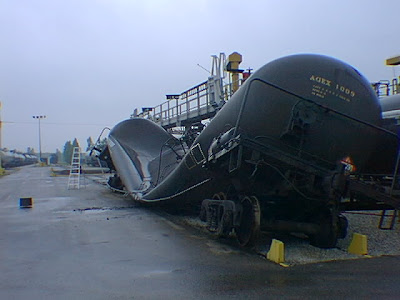
This post will share a screen shot of rail car collapsed due to vacuum condition. The rail car had been steamed out and remained hot inside when it started to rain. Quick cooling due to rain running on the rail car and lead to generation of vacuum.
- Tips on Succession in FREE Subscription
- Subscribe FREE - Chemical Processing
Vaccum hazard is potentially a hazard and damaging factor to many pressure vessel. Vacuum should be addressed and extra caution to be taken during design, construction, operation and maintenance to avoid catastrophic failure.In previous posts, "Vacuum Hazard - Another Catastrophic Factor..." discussed about the damage of vacuum, main factors resulting Vacuum and several scenario may lead to Vacuum Hazard. "4-steps Approach to Combat Vacuum Hazard" discuss about approach may be taken to minimize and avoid Vacuum Hazard. "How powerful is ATMOSPHERIC ?" also has presented a video clip demonstrates how powerful is ATMOSPHERIC pressure and how quick a "vessel" collapse.
This post will share a screen shot of rail car collapsed due to vacuum condition. The rail car had been steamed out and remained hot inside when it started to rain. Quick cooling due to rain running on the rail car and lead to generation of vacuum.

Tuesday, March 3, 2009
Display problem ? Click HERE
An explosion occurred in Shanghai LNG Terminal when the construction worker conducting pneumatic test of the equipment on Feb 06 2009. ONE worker was killed and 15 injured in an explosion on a construction site at Shanghai's Yangshan Deep Water Port. The accident happened at a Shanghai LNG Co Ltd work site on Ximentang Isle, north of the Yangshan Deep Water Port, an international shipping center about 45 kilometers from Pudong International Airport. This LNG terminal is expected to receive 3 million tons of the fuel annually after the first phase becomes operational this year. When the facility is online, LNG shipped by sea from Malaysia will be transformed into a gaseous state and sent to downtown Shanghai through pipes.

Recommended :
- Subscribe FREE - Processing Magazine
- Tips on Succession in FREE Subscription
 The man who died was pierced by a flying steel rod while lying in his dormitory bed. He was pronounced dead at the scene, his co-workers told reporters. The explosion occurred during a pressure test of the equipment, according to the city government media office. Workers were pumping air into a gasifier when some 500 meters of the piping network burst into fragments, buckling cement crossbeams.
Following are collection of article that helps you to educate yourself or your operators related to Pneumatic test :
Pneumatic Test Accident in Singapore
On May 22, 2002, a fatal accident occurred in Singapore involving the failure of a refrigerant receiver during a pneumatic test. In light of this incident, it is appropriate to again remind our readers of the hazards involved in pneumatic tests and to review the precautions that must be taken in conducting such tests.
Hazards of Trapped Pressure and Vacuum
A leak test on a heat exchanger was being conducted using low pressure gas when the tube bundle was ejected with great force striking two employees. One of them died on massive internal injuries...
Pipeline fails under air pressure test - Kills worker
Two workers had completed laying a 30 metre length of 300 mm diameter PVC pipe, in order to connect it to an existing steel pipe, along a suburban roadside. The pipe was then to be pneumatically tested up to a pressure of 690 kPa (100 psi)...
Pneumatic Test Operation Maintenance
This tank is intended for use vented to atmosphere. For outdoor applications, install a weatherproof vent hood or cap on the vent riser pipe and on the interstitial space vent of double wall tanks.
Pneumatic Test - Incident in Brazil
Incident happened in a non-ExxonMobil facility in Brazil during a pneumatic test of the tank associated piping. A blind was NOT installed to isolate the ...
Pdf
Pneumatic Test - IncidentASTM A1047 / A1047M - 05
ASTM A1047 / A1047M - 05 Standard Test Method for Pneumatic Leak Testing of Tubing
Read others incident...Click HERE
Related Post
- Subscribe FREE - Processing Magazine
- Tips on Succession in FREE Subscription
The man who died was pierced by a flying steel rod while lying in his dormitory bed. He was pronounced dead at the scene, his co-workers told reporters. The explosion occurred during a pressure test of the equipment, according to the city government media office. Workers were pumping air into a gasifier when some 500 meters of the piping network burst into fragments, buckling cement crossbeams.Following are collection of article that helps you to educate yourself or your operators related to Pneumatic test :
Pneumatic Test Accident in Singapore
On May 22, 2002, a fatal accident occurred in Singapore involving the failure of a refrigerant receiver during a pneumatic test. In light of this incident, it is appropriate to again remind our readers of the hazards involved in pneumatic tests and to review the precautions that must be taken in conducting such tests.
Hazards of Trapped Pressure and Vacuum
A leak test on a heat exchanger was being conducted using low pressure gas when the tube bundle was ejected with great force striking two employees. One of them died on massive internal injuries...
Pipeline fails under air pressure test - Kills worker
Two workers had completed laying a 30 metre length of 300 mm diameter PVC pipe, in order to connect it to an existing steel pipe, along a suburban roadside. The pipe was then to be pneumatically tested up to a pressure of 690 kPa (100 psi)...
Pneumatic Test Operation Maintenance
This tank is intended for use vented to atmosphere. For outdoor applications, install a weatherproof vent hood or cap on the vent riser pipe and on the interstitial space vent of double wall tanks.
Pneumatic Test - Incident in Brazil
Incident happened in a non-ExxonMobil facility in Brazil during a pneumatic test of the tank associated piping. A blind was NOT installed to isolate the ...
Pneumatic Test - IncidentASTM A1047 / A1047M - 05
ASTM A1047 / A1047M - 05 Standard Test Method for Pneumatic Leak Testing of Tubing
Read others incident...Click HERE
Related Post
- Communication Breakdown...Key to Failure...
- "Fire from Ice" - Lesson Learned & Key Recommendations
- Compressed Gas Incident - Awareness & Learning Fundamentals...
- Pipeline rupture In Varanus Island
- Break the Rules... Pay the Price...
- Vacuum Hazard - Another Catastrophic Factor...
- Extra Caution When Eliminating Overpressure by Fire Attacks
Labels: Accident, Learning, LNG
Wednesday, July 30, 2008
Display problem ? Click HERE
Recommended :
- Subscribe FREE - Processing Magazine
- Tips on Succession in FREE Subscription
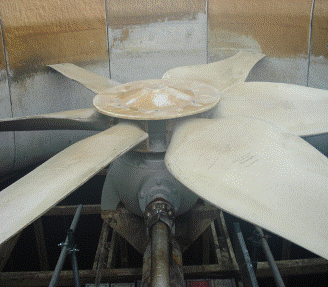
On May 2, 2008 at 1010 hours, during plant start-up towards the end of plant turnaround, an incident occurred in a cooling water cell where a contractor suffered several cuts resulted multiple injuries on his forehead, fractured elbows and collar bone after being hit by the fan blade. The fan was energized without notice and aware of contractor still working inside the cooling water cell.
The root cause as identified :
- Subscribe FREE - Processing Magazine
- Tips on Succession in FREE Subscription
On May 2, 2008 at 1010 hours, during plant start-up towards the end of plant turnaround, an incident occurred in a cooling water cell where a contractor suffered several cuts resulted multiple injuries on his forehead, fractured elbows and collar bone after being hit by the fan blade. The fan was energized without notice and aware of contractor still working inside the cooling water cell.
A TOTAL COMMUNICATION BREAKDOWN !!!
The root cause as identified :
- Communication breakdown between different parties (the contractor working at the fan blade, safety watch and the personnel who activated the push button).
- Insufficient understanding on the typical confine space safety requirements and the need to develop specific Job Safety Analysis (JSA) for the job.
- Procedure not comprehensive to address safe work method while performing the job.
- Inadequate lock-out tag out (LOTO) for in situ balancing trial run.
Recommended :
Subscribe FREE - Legal Aspects of Incident Investigation
 Lessons Learnt:
a) Enhance communication and to physically reconfirm that nobody is in the confine space prior to start-up of any equipment
b) Provide refresher briefing to all operation and maintenance staff on the typical confine space and JSA requirements.
c) Review procedure and include safe job method statement for in-situ balancing trial run.
d) Strengthened the LOTO mechanism for in-situ balancing trial run
e) Implement key-interlocking system where fan will not be energized until key kept by contractor is released.
Related Post
- "Fire from Ice" - Lesson Learned & Key Recommendations
- Compressed Gas Incident - Awareness & Learning Fundamentals...
- Pipeline rupture In Varanus Island
- Break the Rules... Pay the Price...
- Vacuum Hazard - Another Catastrophic Factor...
- Extra Caution When Eliminating Overpressure by Fire Attacks
- Blast rocks Texas oil refinery
Wednesday, July 16, 2008
Recommended :
Subscribe FREE - Legal Aspects of Incident Investigation
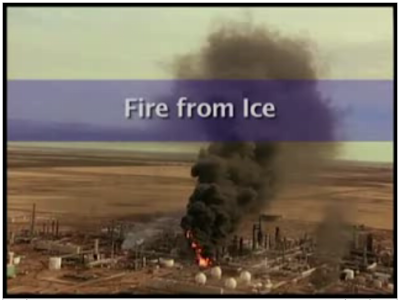
7 months ago, on February 16, 2007, 2.09pm, a big blast in Valero McKee Refinery in Sunray, Texas, 65 miles North of Amarillo. This major event has occurred in the Propane Deasphalting unit and caused three workers critically injured, and the major refinery shut down for two months.
Subscribe FREE - Legal Aspects of Incident Investigation
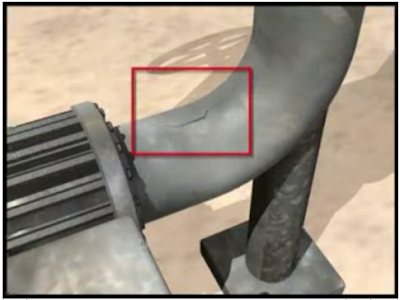
7 months ago, on February 16, 2007, 2.09pm, a big blast in Valero McKee Refinery in Sunray, Texas, 65 miles North of Amarillo. This major event has occurred in the Propane Deasphalting unit and caused three workers critically injured, and the major refinery shut down for two months.CSB has conducted investigation and release it final report on July 09, 2008. As per the studies, the major cause of this accident was foreign material inhibit proper isolation resulted water passing a isolation valve, ice formed in a isolated dead leg during cold weather and ice expansion [1] caused the dead leg piping cracked. Once the ice is melted, large amount of propane is leak through the crack and jet fire form. Jet fire further damage another flange and generated another jet fire impinged on a major non-fireproofed piperack. Finally piperack collapsed resulted major release of flammable hydrocarbon and serious plant fire.
[1] : Why does water expand when it freezes?


[1] : Why does water expand when it freezes?
Dead leg piping cracked due to ice expansion
Pressurized propane leak via crack
Valero Refinery Propane Fire Safety Video
Details investigation report can be downloaded via this link (click here).
From the investigation, several observations in API code & standard have been reported :
- API guidance does not specifically discuss the use of remotely operated Shut-off valve (ROSOV) in controlling jet fires
- API recommends structural steel fireproofing upto 50 feet. However, the CSB investigation found the fire damage can reach 77 feet.
- Radiation caused the LPG storage external paint blistering as a result of operator could not initiate the deluge system on LPG tank due the valve is too close to the incident area
- Hazard Analysis has not evaluated the storing of Chemical product i.e Chlorine in the plant. API do not require hazards analysis from nearby unit when locating fire water deluge valves
- identification of infrequently used piping or equipment subject to freezing
- establishment freeze protection written program
- specific approaches to eliminate freeze hazards
- periodic inspections
- addresses jet fire scenarios, use of protective fireproofing and other measures (e.g., emergency isolation valves, depressuring systems)
- Use remotely operated Shut-off valve (ROSOV) and interlocked equipment controls for quick isolation
- effective deluge system activation during emergencies
- replacing chlorine with biocide for cooling water
Subscribe FREE - Processing Magazine
Most of above recommendations have also been discussed in "Protective Measures against FIRE other than Pressure Relief Device (PRD)" and "Some Comments on Providing External Insulation as Protective Measure against FIRE".Those design trying to eliminate fire scenario in the plant as discussed "Extra Caution When Eliminating Overpressure by Fire Attacks" shall be addressed carefully and extra effort shall be put in .
Source :
CSB - Valero Refinery Propane Fire
Report: Valero refinery fire caused by leak
Related Post
- Compressed Gas Incident - Awareness & Learning Fundamentals...
- Pipeline rupture In Varanus Island
- Break the Rules... Pay the Price...
- Vacuum Hazard - Another Catastrophic Factor...
- Extra Caution When Eliminating Overpressure by Fire Attacks
- Blast rocks Texas oil refinery
Labels: Accident, Fire, Learning
Tuesday, July 15, 2008
Display problem ? Click HERE
Recommended :
Subscribe FREE - Processing Magazine
There was an incident happened recently near a factory involved 3 cars on the roads. A small truck carried 2 Acetylene gas cylinders and 2 Oxygen gas cylinder at the back caught fire in the middle of road. The cylinder on fire flew like a bullet, hit at first car, penetrated the car roof and final stopped after hit at second car front bumper. No details revealed...
Subscribe FREE - Processing Magazine
There was an incident happened recently near a factory involved 3 cars on the roads. A small truck carried 2 Acetylene gas cylinders and 2 Oxygen gas cylinder at the back caught fire in the middle of road. The cylinder on fire flew like a bullet, hit at first car, penetrated the car roof and final stopped after hit at second car front bumper. No details revealed...
Following are some photos captured for view :
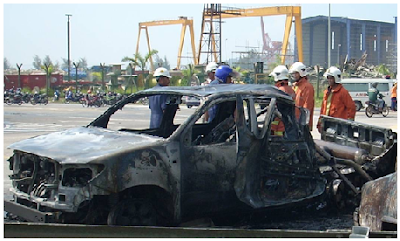
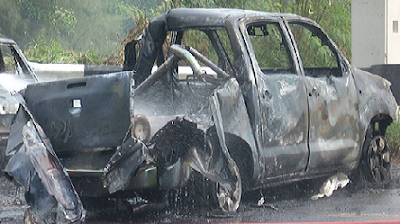
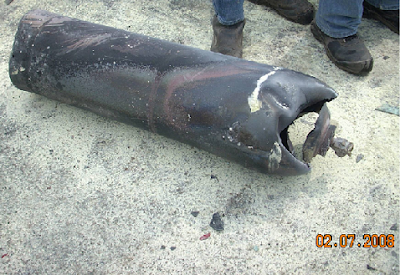
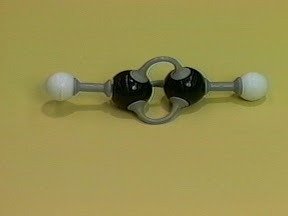
Acetylene (IUPAC name: ethyne) , C2H2, is a unstable and unsaturated triple bonded hydrocarbon in gas form. It common store as compressed gas in cylinder. Similarly an Oxygen cylinder is compressed oxygen store in cylinder. Acetylene and Oxygen are commonly used for welding (known as Oxy-acetylene welding), cutting, heat treatment and coating. As the car carried Acetylene & Oxygen gas cylinder, it is obvious that the owner use them for welding and cutting purpose.
Recommended :
Subscribe FREE - Chemical Processing
A simple Material Safety Datasheet (MSDS) for Acetylene is located here (click here). From the MSDS, acetylene is extremely flammable (low flash point) and explosive. IT MAY DECOMPOSE VIOLENTLY IN ITS FREE STATE UNDER PRESSURE IN EXCESS OF 15 PSIG.
Following is a video clip shows you how "explosive" is if Acetylene mix with Oxygen.
(If you can not view the video clip, click here to view via browser)
How "explosive" is if Acetylene mix with Oxygen
If you or your operators are handling compressed gas i.e. Acetylene, Oxygen, Nitrogen, etc, be sure you and your operators are well aware of the properties of the gases, the way to handle, transport and operate them in the safe manner. Following are collection of article that helps you to educate yourself or your operators :
Gas Cylinder Awareness Outline
The purpose of this awareness training is to help staff and students understand how compressed gas cylinders (CGC) work and how to handle them safely. The training should address the following objectives:
This program contains requirements for practices designed and implemented to protect University employees from the hazards of compressed gases as identified by the University and as defined by OSHA in 29 CFR 1910, the National Fire Protection Association (NFPA) and the Compressed Gas Association (CGA).
Gas Cylinder Safety
A brief discussion on grades of gases, normal storage pressure, type of fitting and regulators used, transportation, storage, how to keep safe of compressed gases, problems related to regulators, information on fire and other aspect.
Gas Cylinder Handling & Storage
Gas cylinders are constructed and maintained in accordance with regulations of the Department of Transportation (DOT). The purchaser should make sure all cylinders bear DOT specification markings, and the contents should be legibly marked on each cylinder in large letters....
Compressed Gas Cylinder Storage and Handling
Compressed gas cylinders are used in many workplaces to store gases that vary from extremely flammable (acetylene) to extremely inert (helium). Many compressed gas cylinders are stored at extremely high pressures (up to 2,500 pounds per square inch gauge or PSIG). A sudden release of these gases can cause a cylinder to become a missile-like projectile. Cylinders have been known to penetrate concrete-block walls. If handled properly compressed gas cylinders are safe. If handled improperly, the same cylinders can present a severe hazard to you and the surrounding area.
Guidelines for Gas Cylinders
This document is an advisory text which sets out general guidelines for the safe storage and handling of gas cylinders. Further information may be obtained from the documented references and the Heath, Safety & Environment Unit. Gas cylinders are used in many University work areas. Approved methods of handling, storage and transport will ensure safe use by the University staff and contractors.
Acetylene, the Principles of Its Generation and Use
A practical handbook on the production, purification and subsequent treatment of Acetylene for the development of light, heat and power.
Take care with acetylene
This leaflet is for people who use acetylene for welding, cutting and similar processes. It provides information on the fire and explosion hazards of acetylene.
Acetylene Safety Alert
The following safety alert was provided to Dynamic Industries, Inc. by one of our clients and did not occur on any of our projects or work sites. However, we should be aware of the hazards associated with the use of acetylene due to the work processes in which peform do on a daily basis.
Compressed Gas Leak Procedure
Use the following recommended procedures if leaks are detected on compressed gas cylinders or in gas supply systems.
The Beginners Guide to Oxy-Acetylene Welding Equipment
The purpose of this page is to introduce the beginning welder to the equipment used in the Oxy-Acetylene welding process. This will be done starting with the cylinders and ending with the torch tip.
Related Post
Recommended :
Subscribe FREE - Chemical Processing
A simple Material Safety Datasheet (MSDS) for Acetylene is located here (click here). From the MSDS, acetylene is extremely flammable (low flash point) and explosive. IT MAY DECOMPOSE VIOLENTLY IN ITS FREE STATE UNDER PRESSURE IN EXCESS OF 15 PSIG.Following is a video clip shows you how "explosive" is if Acetylene mix with Oxygen.
(If you can not view the video clip, click here to view via browser)
How "explosive" is if Acetylene mix with Oxygen
If you or your operators are handling compressed gas i.e. Acetylene, Oxygen, Nitrogen, etc, be sure you and your operators are well aware of the properties of the gases, the way to handle, transport and operate them in the safe manner. Following are collection of article that helps you to educate yourself or your operators :
Gas Cylinder Awareness Outline
The purpose of this awareness training is to help staff and students understand how compressed gas cylinders (CGC) work and how to handle them safely. The training should address the following objectives:
- Understand the inherent dangers of compressed gas cylinders
- Look to hazard labels, warning signs and MSDS for important information
- Selection of appropriate PPE when working with gas cylinders
- Know how to properly move, handle and store cylinders
- Know what to do in case the cylinder or delivery system develops a leak (e.g., trouble-shooting and emergency procedures)
- Know what problems can occur when installing a cylinder in a gas delivery system (e.g., installing a regulator on a cylinder)
- Know how to check cylinders for potential problems
This program contains requirements for practices designed and implemented to protect University employees from the hazards of compressed gases as identified by the University and as defined by OSHA in 29 CFR 1910, the National Fire Protection Association (NFPA) and the Compressed Gas Association (CGA).
Gas Cylinder Safety
A brief discussion on grades of gases, normal storage pressure, type of fitting and regulators used, transportation, storage, how to keep safe of compressed gases, problems related to regulators, information on fire and other aspect.
Gas Cylinder Handling & Storage
Gas cylinders are constructed and maintained in accordance with regulations of the Department of Transportation (DOT). The purchaser should make sure all cylinders bear DOT specification markings, and the contents should be legibly marked on each cylinder in large letters....
Compressed Gas Cylinder Storage and Handling
Compressed gas cylinders are used in many workplaces to store gases that vary from extremely flammable (acetylene) to extremely inert (helium). Many compressed gas cylinders are stored at extremely high pressures (up to 2,500 pounds per square inch gauge or PSIG). A sudden release of these gases can cause a cylinder to become a missile-like projectile. Cylinders have been known to penetrate concrete-block walls. If handled properly compressed gas cylinders are safe. If handled improperly, the same cylinders can present a severe hazard to you and the surrounding area.
Guidelines for Gas Cylinders
This document is an advisory text which sets out general guidelines for the safe storage and handling of gas cylinders. Further information may be obtained from the documented references and the Heath, Safety & Environment Unit. Gas cylinders are used in many University work areas. Approved methods of handling, storage and transport will ensure safe use by the University staff and contractors.
Acetylene, the Principles of Its Generation and Use
A practical handbook on the production, purification and subsequent treatment of Acetylene for the development of light, heat and power.
Take care with acetylene
This leaflet is for people who use acetylene for welding, cutting and similar processes. It provides information on the fire and explosion hazards of acetylene.
Acetylene Safety Alert
The following safety alert was provided to Dynamic Industries, Inc. by one of our clients and did not occur on any of our projects or work sites. However, we should be aware of the hazards associated with the use of acetylene due to the work processes in which peform do on a daily basis.
Compressed Gas Leak Procedure
Use the following recommended procedures if leaks are detected on compressed gas cylinders or in gas supply systems.
The Beginners Guide to Oxy-Acetylene Welding Equipment
The purpose of this page is to introduce the beginning welder to the equipment used in the Oxy-Acetylene welding process. This will be done starting with the cylinders and ending with the torch tip.
Related Post
Labels: Accident, Ebook, Safety
Friday, June 13, 2008
Display problem ? Click HERE
Recommended :
 BP went to spud Polaris deep BB II. They spudded on top of an old Telegraph cable that was 3 mile long. They pulled the Drill string BHA last night at 5pm & at 1pm on the 15th May and they are still trying to remove the cable...
If the old Telegraph cable route map information is available, BP may avoid this accident, schedule delay, additional unexpected cost, etc. You can imagine how important is information and information management...


- Pipeline rupture In Varanus Island
- Break the Rules... Pay the Price...
- Vacuum Hazard - Another Catastrophic Factor...
- Dust Explosion Basic & Protection
- Extra Caution When Eliminating Overpressure by Fire Attacks
- Blast rocks Texas oil refinery
Labels: Accident
Thursday, June 5, 2008
Display problem ? Click HERE
Pipeline rupture and fire caught at Apache Corporation's Vanarus Island facility in Western Australia has shocked the Apache management and seriously affect the the Natural gas supply to Western region of Australia. No personnel was injured in this event. See following images of the accident.
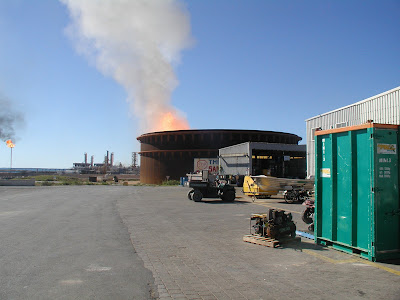
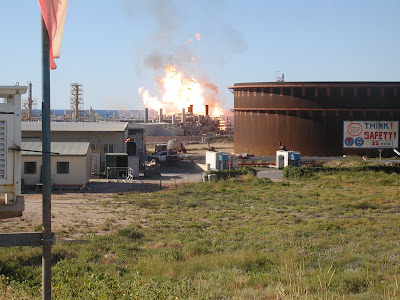
The cause of this accident is yet to be released...
Read more in
- Apache Energy extinguishes fire at off-shore gas plant
- Apache pipeline fire - Varanus Island, Western Australia
- Fire ruptures WA gas supply
- Gas plant remains in shutdown after explosion
- Apache Reports Pipeline Rupture and Fire at Varanus Island Processing Hub Offshore Western Australia
- Break the Rules... Pay the Price...
- Vacuum Hazard - Another Catastrophic Factor...
- Dust Explosion Basic & Protection
- Extra Caution When Eliminating Overpressure by Fire Attacks
- Blast rocks Texas oil refinery
- Petrol Kiosk - Some Thought and Advices...
- Design fault in Hydrogen Attack of Residue Hydrodesulfurrization
Labels: Accident
Wednesday, May 21, 2008
Display problem ? Click HERE
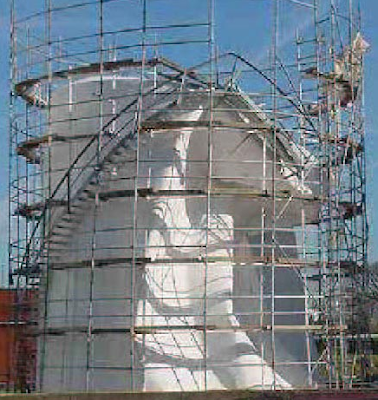
"Vacuum Hazard - Another Catastrophic Factor..." discuss about the damage of vacuum, main factors resulting Vacuum and several scenario may lead to Vacuum Hazard. "4-steps Approach to Combat Vacuum Hazard" discuss about approach may be taken to minimize and avoid Vacuum Hazard.
The following video clip will demonstrates how powerful is ATMOSPHERIC pressure and how quick a "vessel" collapse.
* Click here to view video clip via browser...
Related Post
Have your ever seen how quick a "vessel" collapse ?
The following video clip will demonstrates how powerful is ATMOSPHERIC pressure and how quick a "vessel" collapse.
Courtesy of Lightmypump
* Click here to view video clip via browser...
Related Post
Monday, May 12, 2008
Display problem ? Click HERE
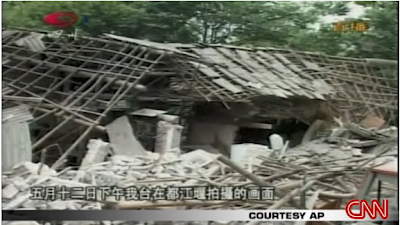
7.9-magnitude powerful earthquake in region around ChengDu, central China has caused thousand killed and more than 10,000 were believed to be injured. This figure is increasing...
This earthquake has collapsed two chemical plants in Sichuan's Shifang city. The collapsed chemical plants have buried hundreds of people and more than 80 tons of ammonia leaked out. Can not imagine how many more peoples will be killed by ammonia gas...
- View "Quake hit chemical plants" video clip...
- Read details of this tragedy...
- Read more DANGER of AMMONIA...
- Break the Rules... Pay the Price...
- Vacuum Hazard - Another Catastrophic Factor...
- Dust Explosion Basic & Protection
- Extra Caution When Eliminating Overpressure by Fire Attacks
- Blast rocks Texas oil refinery
- Petrol Kiosk - Some Thought and Advices...
- Design fault in Hydrogen Attack of Residue Hydrodesulfurrization
Labels: Accident
Thursday, April 10, 2008
Display problem ? Click HERE
Vaccum hazard is potentially a hazard and damaging factor to many pressure vessel. Vacuum should be addressed and extra caution to be taken during design, construction, operation and maintenance to avoid catastrophic failure. Following are four (4) steps approach to combat vacuum hazard.
Avoid it
This is the first principle to be adopted in any design and operation. System shall be designed and operating procedures shall be implemented to avoid the occurrence of vacuum condition in a vessel.
Whenever there is a potential of vacuum can be created, an automatic control system may be implemented to prevent it from occur. Some typical control system could be
Whenever the control system as mentioned in earlier section can not prevent it to happen, provide a high level shutdown system to stop continuous further creation of vacuum. Typically a highly reliable low-low pressure trip is provided to stop a external mechanical driver to continue operate e.g. stop reciprocating pump which is drawing water from a vessel.
Protect it- Vessel to be kept pressurized during cooling until the vessel and it contents cooled to ambient temperature.
- Vessel to be purged with inert gas prior to any cooling cycle
Whenever there is a potential of vacuum can be created, an automatic control system may be implemented to prevent it from occur. Some typical control system could be
- Inert gas blanketing system to maintain positive pressure in the vessel
- Continuous purging system in the flare header
- Application of insulation layer to avoid sudden heat loss to ambient
Whenever the control system as mentioned in earlier section can not prevent it to happen, provide a high level shutdown system to stop continuous further creation of vacuum. Typically a highly reliable low-low pressure trip is provided to stop a external mechanical driver to continue operate e.g. stop reciprocating pump which is drawing water from a vessel.
This is the last resource but shall be implemented whenever a risk of vacuum is identified and present.The main concept is provide a system or device to sustain or break the vacuum whenever it occurred.
Related Post
- Design the system for FULL VACUUM
Full vacuum (FV) — a condition where the internal absolute pressure is 0 psi (0 KPa) and the external absolute pressure on the vessel is 15 psi (100 KPa).
- Provide Pressure-Vacuum-Relief-Valve (PVRV) to break vacuum in case it occurred.
- May consider to provide liquid seal as vacuum breaker
Related Post
- Vacuum Hazard - Another Catastrophic Factor...
- Parallel Valve Technology Increase Safety & Reduce Nuisance Trips
- Dust Explosion Basic & Protection
- Why not bury flare pipe header ?
- Extra Caution When Eliminating Overpressure by Fire Attacks
- Blast rocks Texas oil refinery
- Petrol Kiosk - Some Thought and Advices...
- Design fault in Hydrogen Attack of Residue Hydrodesulfurrization
Wednesday, April 9, 2008
Display problem ? Click HERE
Benoy in his early thread " Vacuum For Pressure Vessel Design" has triggered to think a little more on an old subject "Vacuum Hazard".
What is Vacuum Hazard ?
Vacuum or negative pressure can be dangerous and damaging to vessel as many vessel structures may not be built to withstand reversed stresses caused by negative pressure or vacuum. Following images show vessel collapsed caused by Vacuum.
What are the main factors resulting Vacuum ?
TWO main factors are potentially the best candidates result Vacuum in a vessel. There are External mechanical draw and Internal contraction.
Several scenario you may have to consider potential of Vacuum Hazard
i) Vessel containing fluid with vapor pressure at minimum ambient temperature lower than atmospheric. Typical example is the steam-condensate system. A steam drum shut down and cool down normal ambient cooling. As the steam cooled, it will start to condense and condensation lead to sudden volume contraction and this potential causing partial vacuum condition in the steam drum. Main factor is internal contraction due to heat loss.
ii) Atmospheric tank storing hot liquid. Similarly external cooling would cause liquid contraction and lead to partial vacuum in the tank. Main factor is internal contraction due to heat loss.
iii) Gravity draining of vessel filled with low vapor pressure (VP) liquid (i.e. water). Draining of low VP liquid out from vessel (completely blocked) would results negative pressure or partial vacuum in the vessel due to liquid column. Main factor is external mechanical draw by gravity force.
iv) Reciprocating pump drawing low VP liquid from vessel. Reciprocating pump continue drawing liquid from vessel would also lead to vacuum in the vessel. Again, the main factor is external mechanical draw by mechanical force.
v) Hot Relief into Flare Header. After a hot gas relief into the flare header, the hot gas in the header will be cooled by ambient. This would be accelerated with raining, snowing, winter, etc. Again, hot gas cooling may result condensation and potential create partial vacuum in the flare header. Main factor is internal contraction due to heat loss.
vi) Blocked Vent line. Bird nest or plastic in the vent line would partially or completely blocked the vent line. This potentially causing partial vacuum in the tank when the tank is cooled or pump-out. Main factor could be internal contraction due to heat loss or external mechanical draw by mechanical force.
Thus, vacuum may be a hazard and damaging factor to your system. It shall be addressed and extra caution to be taken during design, construction, operation and maintenance to avoid catastrophic failure.
Click to read 4-steps Approach to Combat Vacuum Hazard ...
Related Post
WebWorm
What are the main factors resulting Vacuum ?
TWO main factors are potentially the best candidates result Vacuum in a vessel. There are External mechanical draw and Internal contraction.
- External mechanical draw
This factor basically cause by a external mechanical force to draw mass in the vessel out and creating vacuum in the vessel. Typical example are vacuum compressor, steam ejector, etc.
- Internal Contraction
Temperature different results internal heat is forced to transmit out from the vessel and internal fluid experience sudden contraction due to condensation. Typical example is steam-condensate drum.
Several scenario you may have to consider potential of Vacuum Hazard
i) Vessel containing fluid with vapor pressure at minimum ambient temperature lower than atmospheric. Typical example is the steam-condensate system. A steam drum shut down and cool down normal ambient cooling. As the steam cooled, it will start to condense and condensation lead to sudden volume contraction and this potential causing partial vacuum condition in the steam drum. Main factor is internal contraction due to heat loss.
ii) Atmospheric tank storing hot liquid. Similarly external cooling would cause liquid contraction and lead to partial vacuum in the tank. Main factor is internal contraction due to heat loss.
iii) Gravity draining of vessel filled with low vapor pressure (VP) liquid (i.e. water). Draining of low VP liquid out from vessel (completely blocked) would results negative pressure or partial vacuum in the vessel due to liquid column. Main factor is external mechanical draw by gravity force.
iv) Reciprocating pump drawing low VP liquid from vessel. Reciprocating pump continue drawing liquid from vessel would also lead to vacuum in the vessel. Again, the main factor is external mechanical draw by mechanical force.
v) Hot Relief into Flare Header. After a hot gas relief into the flare header, the hot gas in the header will be cooled by ambient. This would be accelerated with raining, snowing, winter, etc. Again, hot gas cooling may result condensation and potential create partial vacuum in the flare header. Main factor is internal contraction due to heat loss.
vi) Blocked Vent line. Bird nest or plastic in the vent line would partially or completely blocked the vent line. This potentially causing partial vacuum in the tank when the tank is cooled or pump-out. Main factor could be internal contraction due to heat loss or external mechanical draw by mechanical force.
Thus, vacuum may be a hazard and damaging factor to your system. It shall be addressed and extra caution to be taken during design, construction, operation and maintenance to avoid catastrophic failure.
Click to read 4-steps Approach to Combat Vacuum Hazard ...
Related Post
- 4-steps Approach to Combat Vacuum Hazard
- Parallel Valve Technology Increase Safety & Reduce Nuisance Trips
- Dust Explosion Basic & Protection
- Why not bury flare pipe header ?
- Extra Caution When Eliminating Overpressure by Fire Attacks
- Blast rocks Texas oil refinery
- Petrol Kiosk - Some Thought and Advices...
- Design fault in Hydrogen Attack of Residue Hydrodesulfurrization
WebWorm
Friday, March 21, 2008
Display problem ? Click HERE
One man accidentally press the emergency push button and initiated the inflation...
Can you imagine if this man doing the same thing in your plant ?
BE ALERT !
Similar Post
- Blast rocks Texas oil refinery
- Petrol Kiosk - Some Thought and Advices...
- Design fault in Hydrogen Attack of Residue Hydrodesulfurrization
Labels: Accident
Monday, March 10, 2008
Display problem ? Click HERE

 Monday morning, about 8.20am local time, explosion at the Alon Refinery in Big Spring, Texas was a reminder to all personnel involve in the oil and gas business... Never tolerate on Safety.
Recent high oil and LNG price leads a lot of oil & gas projects. All operator and plant owner are chasing the contractor to deliver their plant with extremely short schedule. As compare to similar capacity plant in 5-10 years ago, the schedule has probably reduce by 30-50%.


Last year, a well known operator approached us to quote for a project with 2 satellite, 1 riser and 1 center processing platform (CPP). It imposed an extremely stringent requirement. Guess what ? Entire conceptual and Detailed Design shall be completed within 5 months ! Being a responsible engineer, the only response to this request is "No. I am sorry. I just can't deliver".
BREAK THE RULE, PAY THE PRICE.
Below are photos of this accident.


Thanks to Mohan for sharing the photos...
Related Post
- Blast rocks Texas oil refinery
- Petrol Kiosk - Some Thought and Advices...
- Design fault in Hydrogen Attack of Residue Hydrodesulfurization
Labels: Accident
Monday, February 18, 2008
Display problem ? Click HERE
An explosion rocked a Texas oil refinery located a Big Spring Texas, Monday morning (about 8.20am local time), shaking homes three miles away. Massive cloud of smoke forming over the refinery. One worker was injured in the blast, and all workers had been accounted for. Read more news and video clip... (Click HERE).
Similar Post
An explosion rocked a Texas oil refinery located a Big Spring Texas, Monday morning (about 8.20am local time), shaking homes three miles away. Massive cloud of smoke forming over the refinery. One worker was injured in the blast, and all workers had been accounted for. Read more news and video clip... (Click HERE).Similar Post
- Petrol Kiosk - Some Thought and Advices...
- Design fault in Hydrogen Attack of Residue Hydrodesulfurization
Labels: Accident
