Sunday, March 7, 2010

Cooling Tower is widely used in Refinery and PetroChemical Industry to remove heat from process system and rejected heat into atmospheric which act as natural heat sink. In earlier post "Useful Documents Related to Cooling Tower", there are many useful articles related to Cooling Tower. This post will includes two additional articles from SPX Cooling Technologies.
ClearSky™ Plume Abatement Brochure (New)
More articles in "Useful Documents Related to Cooling Tower" ...
Related Topic
- Quick Water Balance Around Cooling Tower
- Cooling Tower Thermal Design Manual
- How much heat removal by natural convection when Air Cooler fan off
- Success story of turbulator in Air Cooled Heat Exchanger
- Heat Transfer Coefficient For Air-Cooled Heat Exchangers
- Air Cooled Heat Exchanger Control using Variable Pitch Fans
- Design of Quiet Air-Cooled Heat Exchangers
Labels: Air Cooler, Cooling Tower, Heat Exchanger


Sunday, March 30, 2008
 In site experiencing summer and winter, normally the air cooler (heat transfer area) will be designed based on maximum ambient air temperature during summer. However, ambient air temperature will drop significantly during winter and those air cooler handling wet gas (saturated with water vapor or free water found in vapor phase) will potentially experience hydrate formation as the fluid temperature cooled below the hydrate formation temperature of fluid. How the tackle this kind of issue ?
There are few practical means to tackle hydrate formation downstream of air cooler which only occur during winter.
(i) Manual shutdown of fans
(ii) Auto-Control Air Flow
You may aware that other than above mentioned benefit, there are other benefits as discussed in Variable Frequency Drive (VFD) helps in Many Aspects (click here).
VSD control is one the effective means in controlling air cooler outlet temperature. There are other means of controlling the temperature as discussed in Air Cooled Heat Exchanger Control using Variable Pitch Fans.
(iii) Inject Hydrate Inhibitor upstream of Air cooler
This is one of the common method in controlling hydrate formation. However, the continuous consumption of hydrate inhibitor could lead to high life cycle cost of the plant and may not be attractive at all. Apart, there are other problems associate with hydrate inhibitor (i.e. methanol, MEG, TEG, etc). If methanol is used, it will stay in vapor form and follow the vapor to downstream processing facilities. Methanol is not easy to be removed from the gas phase and methanol-water mixtures when it is knocked out as liquid in cold section. If MEG /MEG is used, it potentially poison downstream equipment such as membrane and form a contaminant in gas phase.
Apart, some may consider to provide a bypass around the air cooler so that hot fluid from upstream of air cooler warm with fluid outlet of air cooler and expecting mixture is above hydrate formation temperature. This will ONLY help in fluid downstream of mixing, but hydrate formation still occur upstream of mixing point. Hot bypass DOES NOT HELPS !
Another aspect one shall remember is mal-distribution of air flow within the air cooler tube bundle would lead to some tubes experience higher air flow compare to other tubes and results fluid in some tubes experience temperature lower than hydrate formation temperature. Hence, whenever the hydrate temperature is lower than minimum ambient temperature, mal-distribution of air flow within tube bundle shall be analyzed in detail. Moreover if the fluid entering air cooler is two phase gas liquid flow, phase separation at the distribution header would even worsen above scenario.
Related Post
- How much heat removal by natural convection when Air Cooler fan off
- Success story of turbulator in Air Cooled Heat Exchanger
- Heat Transfer Coefficient For Air-Cooled Heat Exchangers
- Air Cooled Heat Exchanger Control using Variable Pitch Fans
- Design of Quiet Air-Cooled Heat Exchangers
- Should Forced Draft or Induced Draft Air Cooler be employed on offshore platform ?
Labels: Air Cooler, Fan, Heat Exchanger
Sunday, December 9, 2007
 Natural Convection Phenomenon
An air-cooled heat exchanger fan off, heat transfer by natural convection may continuous where the air movement is resulted by the air density difference between cool ambient air and hot air (near tube with hot process fluid) within the tube bundle and duct. Natural air cooling may leads to some adverse and process problem. Two major examples are
1) waxy fluid crystallized & solidified and water freezing in air-cooled heat exchanger
2) Inability for vapor to condensed results vapor passing across air-cooled heat exchanger
Natural Convection Heat removal by Induced Draft & Forced Draft Fan
 Higher heat removal is expected in induced draft compare to forced draft. This could be caused by the location of fan and fan blades. In forced draft (where fan is located below the tube bundle), fan blades will create disturbance of air flow and affect proper air distribution across the tube bundle and leads to lower heat removal. Disturbance of air flow may increases the possibility of vortex (air recirculation) formation between the fan blades and tube bundle. Air recirculation will reduce net cool air intake into tube bundle and lower heat removal.
Credit During Fan Off
Additional Thought
Considering Berryman and Henry studies, credit statement in API STD 521 and still air condition, the reasonable heat removal by natural convection during fan off for induced and forced draft may be 20% and 5% of normal duty respectively.
Besides, as the reasonable heat removal only 5% for forced draft, it has minimum incentive for further optimization and process designer can choose to ignore. However, 20% for induced draft is at it lower end and has reasonable incentive for further optimization, thus process designer may consider take the allowance but shall always confirm with final design during detailed design and fabrication.
Related Topic
- Success story of turbulator in Air Cooled Heat Exchanger
- Heat Transfer Coefficient For Air-Cooled Heat Exchangers
- Air Cooled Heat Exchanger Control using Variable Pitch Fans
- Design of Quiet Air-Cooled Heat Exchangers
- Should Forced Draft or Induced Draft Air Cooler be employed on offshore platform?
Labels: Air Cooler, Fan, Forced Draft, Induced Draft
Thursday, September 6, 2007

As this unit will be installed on existing platform, space and weight constraint are the MAJOR issues. Many efforts have been implemented in order to reduce new installation space and weight. One of them is to reduce the Lube Oil Cooler Size.
Turbulator
The following image demonstrates a wire matrix turbulator by hiTRAN
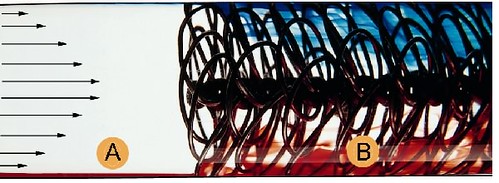
Wire matrix turbulator, known as a HiTRAN® Matrix Element, is inserted into inner tube of Heat Exchanger. The basic principle is to promote fluid mixing, convert laminar flow to turbulence flow pattern, maintaining turbulence flow pattern and improve tube-side heat and mass transfer.
From above image,
- region (A) is laminar flow conditions
- region (B) is turbulence caused by the use of hiTRAN matrix tube Inserts
See below the comparison between Compressor lube oil cooler (Air-Cooled Heat Exchanger) with and without turbulator :
Number of tube rows above each other 5* (with turbulator) 10* (without turbulator)
Width 4* m(with turbulator) 7.3* m (without turbulator)
Length 7.9* m (with tubulator) 12.2* m (without turbulator)
Height 7.2* m (with turbulator) 9.3* m (without turbulator)
* For reference only
Turbulator has significantly reduce the space consume and weight and it ensure the project to proceed to installation phase. Idea of using turbulator is one of the success story in debottlenecking project especially those have space and weight constraints.
Further Reading
Labels: Air Cooler, Heat Exchanger
Monday, August 20, 2007
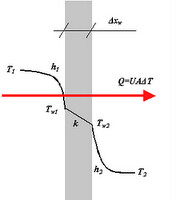
Basic heat transfer relationships is apply to Air-Cooled Heat Exchanger (ACHE) . The fundamental heat transfer equation :
U = overall heat transfer coefficient
A = Heat transfer area
LMTD = Log mean temperature difference
F = Correction factor
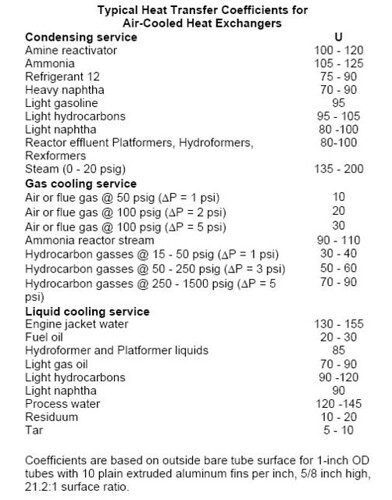
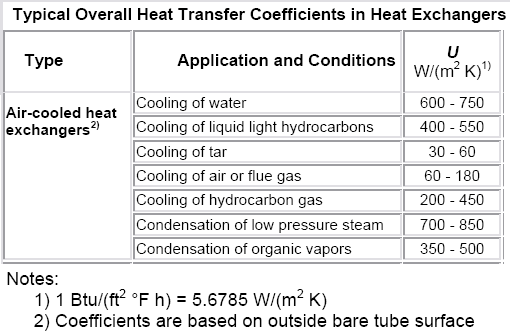
Typical heat transfer coefficient for Air-Cooled Heat Exchangers
Further Reading
Labels: Air Cooler, Heat Exchanger, Heat Transfer
Sunday, August 19, 2007
ii) On-off fan operation (manual)
iii) Two-speed fans (manual or automatic)
iv) Louvers or shutters (automatic)
v) Variable pitch fans (automatic)
vi) Variable speed fans (automatic)
Labels: Air Cooler, Fan, Heat Exchanger
Saturday, August 18, 2007

Further reading
Labels: Air Cooler, Fan, Heat Exchanger
Friday, August 17, 2007

Tuf-Lite
Axial Flow Fans for Air Cooled Heat Exchanger & Cooling tower from HUDSON Product Incorporation (HPC)
Further reading
Labels: Air Cooler, Fan, Heat Exchanger
Thursday, August 16, 2007

Apart from FREE software for download, HUDSON also share other very useful articles in it website...
Basic of Air-Cooled Heat Exchanger (ACHE)
Other very useful articles available for FREE download in HUDSON website are :
Further Reading
Labels: Air Cooler, Fan, Heat Exchanger
Tuesday, August 14, 2007

- Fin-Fan ® Air-Cooled Heat Exchangers
- Hy-Fin ® Extruded Finned Tubing
- Tuf-Lite ® FRP Axial Flow Fans for air coolers and cooling towers.
- Tuf-Lite I I® FRP Axial Flow Fans for air coolers and cooling towers.
- Basics of Air-Cooled Heat Exchangers - This software is designed to familiarize users with the types, components, and features of air-cooled heat exchangers.
- Fan-Rating Program - The Tuf-lite Fan Selection Program is designed to assist customers in selecting the appropriate axial flow fan for their application.
Further reading
Labels: Air Cooler, Fan, Heat Exchanger
Tuesday, July 24, 2007
Should we install Forced Draft (FD) Air Cooler or Induced Draft (ID) Air Cooler on an offshore platform ?
Induced draft fan is generally prefer from air cooling perspective as forced generally more prone to hot air recirculation. However, this potential expose maintenance group to hot air and huge resistance given by the operation & maintenace team.
Benefits / advantages of using forced draught fan are :
- Maintainability - Forced draught fan easier to maintain, better accessibility and handling of fans & drive-assembly
- Power - Lower power consumption for forced draught fan
- Vibration - Less prone to vibration due to shorter fan shaft employed for forced draught fan
- Cost - Lower initial cost and more economical to maintain for forced draught fan
- Space - Forced draught fan require less space, especially lesser plot width
However, disadvantages of using forced draught fan are :
- Inlet air distribution - Less uniform air distribution and higher tendencies of hot air recirculation
- Noise - Forced draught fan has higher noise level
- Control - Less controllability as compare to Induced draft fan
Conclusion from the debate is FORCED DRAFT fan will be installed only after Hot Air Recirculation Analysis using CFD has been carried out to definitely confirm air temperature will not accumulate and affect the air cooler performance.
Further reading :
- Hot Air Recirculation by Air Coolers (3.6MB)A.Y. Gunter and K.V. Shipes, Hudson Products Corp., Sugar Land, Texas
Labels: Air Cooler, Fan, Forced Draft, Induced Draft
Friday, June 15, 2007

API Heat Transfer founded in 1947 in North America, a manufacturer for varieties of heat exchangers include Airtech Basco and Schmidt Bretten ...

HEAT EXCHANGERS...
Basco Type 500 Shell & Tube Heat Exchangers
Basco/Whitlock Hub-Design Heat Exchangers
Basco/Whitlock U-Tube Heat Exchangers
Basco Type OP Heat Exchangers
Basco PLAC Shell & Tube Heat Exchanger
Basco Type ES Extended Surface Plate Fin Heat Exchanger
API Basco Engineered Shell and Tube Heat Exchangers
Shell & Tube product literature & brochures
Airtech Aluminum Air-Cooled Heat Exchangers
Airtech Aluminum Fan-Cooled Heat Exchangers
Airtech PCR Aluminum Heat Exchangers
Air cooled product literature & brochures
Schmidt-Bretten Gasketed Plate Heat Exchangers
Semi-Welded Plate Heat Exchangers
Welded Plate Heat Exchangers
Schmidt-Bretten Brazed Plate Heat Exchangers
PHE literature & brochures
Thermal System literature & brochures
MANUAL...
Basco Type ES Installation & Maintenance Guide
Plate and Frame Heat Exchanger Installation and Maintenance Manual
Airtech Air Cooled Installation, Operating & Maintenance Instructions
ANIMATION...
Animation of Basco Type ES Disassembly
Gasketed Plate and Frame Heat Exchanger Animation
Labels: Air Cooler, Brazed Plate Heat Exchanger, Heat Exchanger, Heat Transfer, U-tube Heat exchanger
